
[ad_1]
Investors sold bank stocks on Thursday, spooked by fears of a possible liquidity crisis in the sector after SVB Financial SIVB said on Wednesday it had sold most of its $21 billion securities portfolio in which it had unrealized losses.
The crisis prompted the US government to take control of the bank on Friday.
SVB, a major lender to early-stage technology and healthcare start-ups, said it would post an after-tax loss of $1.8 billion in the first quarter of 2023.
Liquidity crisis leads to SVB collapse
SVB’s stock fell more than 60% to $106.04 on March 9, 2023, a new 52-week low. Trading in SVB shares was halted before the market opened on Friday, March 10, and the Federal Deposit Insurance Corporation took over the bank’s assets.
“Aside from crypto-related meltdowns, this is one of the first banks we’ve seen to actually experience a liquidity crisis, forcing it to restructure its balance sheet and post losses on its securities portfolios,” said Eric Compton, equity strategist at Morningstar.
He added: “SVB scores significantly worse than any bank we cover in terms of liquidity and unrealized losses. This leads us to think that SVB could face a unique liquidity crisis that need not be system-wide; however, it does emphasize that these risks are now greater. It also highlights that it can be very difficult to predict how financing pressures may change in any given quarter and when these risks may materialize.”
Which banking stocks were hit hardest by the SVB’s plunge?
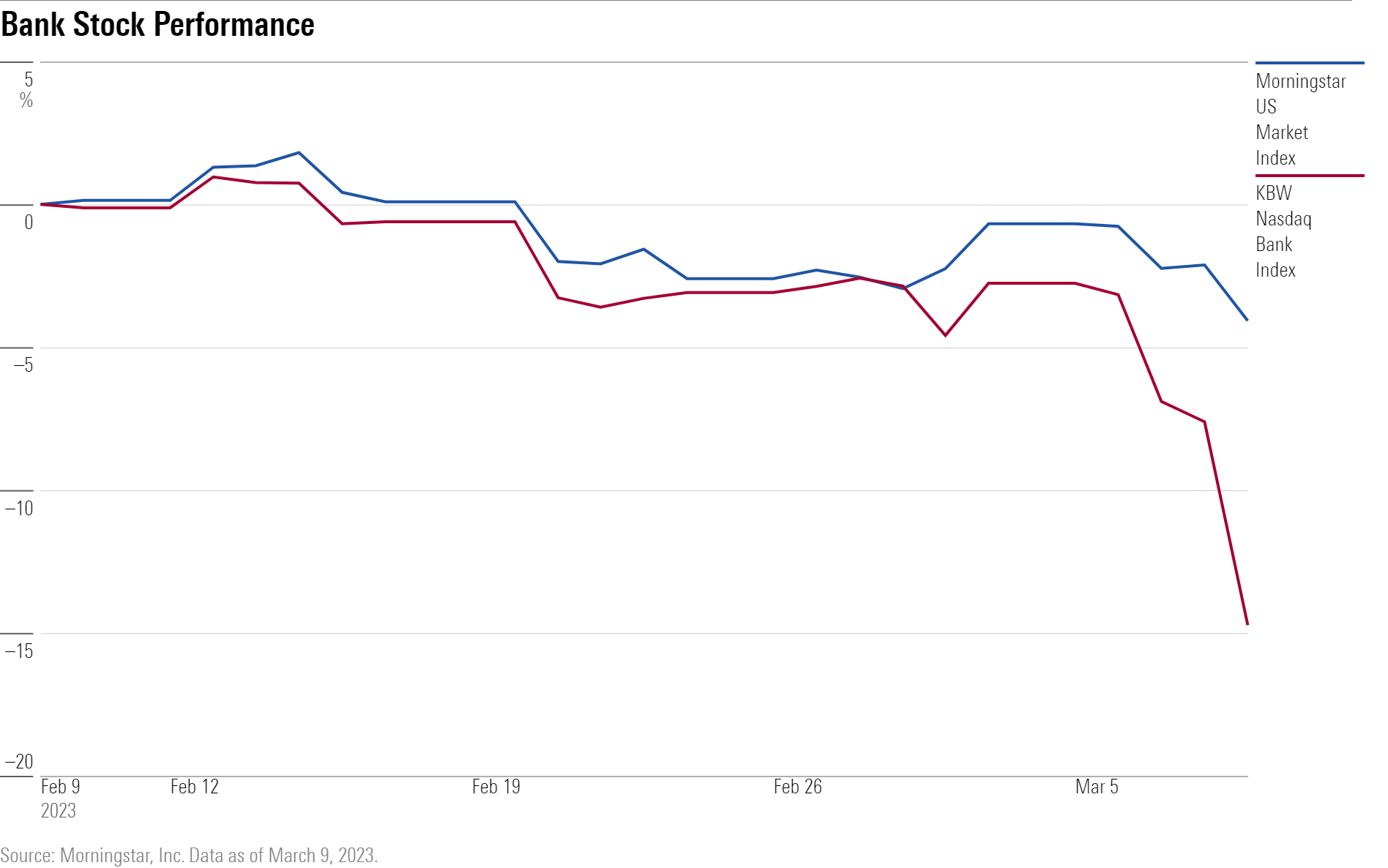
The collapse of the SVB sent other banking stocks crashing, with the KBW Nasdaq Bank Index losing 7.7% on Thursday. The decline continued Friday morning, with the index falling another 1.3% as of 11 a.m. Eastern Time. The index is now down nearly 15.6% over the past month.
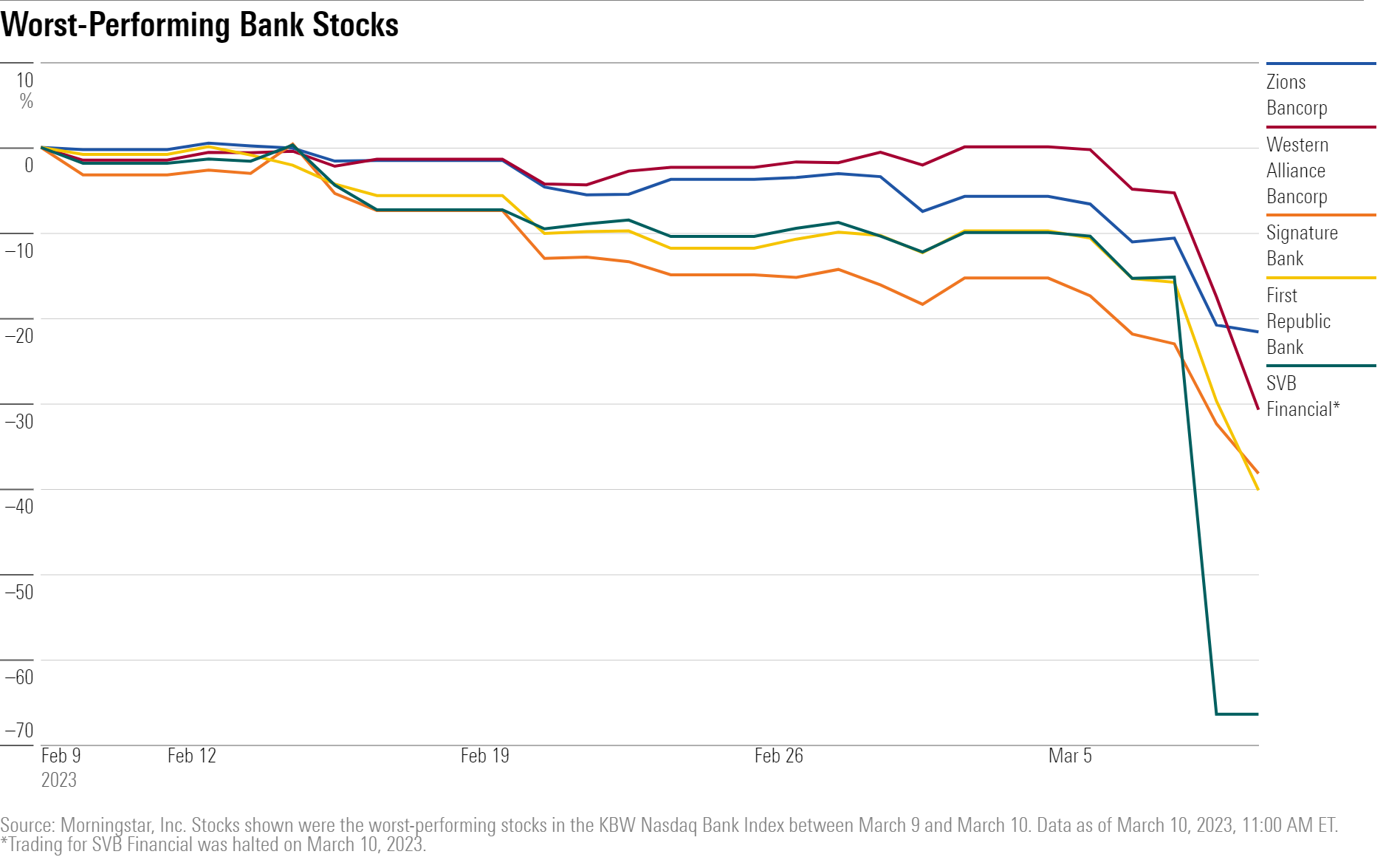
Among the worst performers:
- San Francisco-based First Republic Bank FRC saw its shares plunge 16.5% Thursday and another 15.2% Friday morning.
- Phoenix-based Western Alliance Bancorp WAL stock lost nearly 13.0% Thursday and another 17.1% Friday morning.
- New York-based SBNY shares of Signature Bank fell 12.2% on Thursday and another 8.6% on Friday morning.
- Shares of Salt Lake City-based Zions Bancorp ZION fell 11.4% on Thursday and another 1.9% on Friday morning.
- Dallas-based Comerica CMA fell 8.0% Thursday and another 2.4% Friday morning.
- East West Bancorp EWCB shares in Pasadena fell more than 8.0% Thursday and another 3.7% Friday morning.
- Minneapolis-based US Bancorp USB stock lost 7.0% Thursday and another 2.2% Friday morning.
What happened at SVB?
Compton explains, “Banks bought mortgage-backed securities and government bonds before interest rates started to rise. As interest rates have risen, the prices of these securities have fallen. Banks hold a number of securities that technically have losses, but have not yet materialized.
“The securities pose limited credit risk because government bonds and government-backed MBS carry the explicit or implicit backing of the government. However, if a bank has to sell them at a loss, those losses will flow through the balance sheet and begin to erode equity. This poses a liquidity problem, especially if deposits start to leave banks, which they are. Deposit outflows put increasing pressure on banks to sell existing assets. This risk was lurking beneath the surface, but has just become a reality for SVB in a big way. This is why bank stocks are selling off in response to this news.”
In November 2022, Martin Gruenberg, the chairman of the Federal Deposit Insurance Corporation, signaled mounting unrealized losses in bank securities portfolios as an “overhang” that could soon become “problematic.”
Still, Compton says it does not expect other banks in its coverage area to take similar measures as SVB. He explains that while Truist Financial TFC, U.S. Bancorp, and Bank of America BAC have the largest unrealized losses as a percentage of tangible equity, “their liquidity profiles appear to be much less stressed than SVB.”
The SVB’s actions highlight mounting financing pressures in the banking sector that will put pressure on net interest income, says Compton.
“Liquidity issues are an evolving risk worth keeping an eye on,” he added.
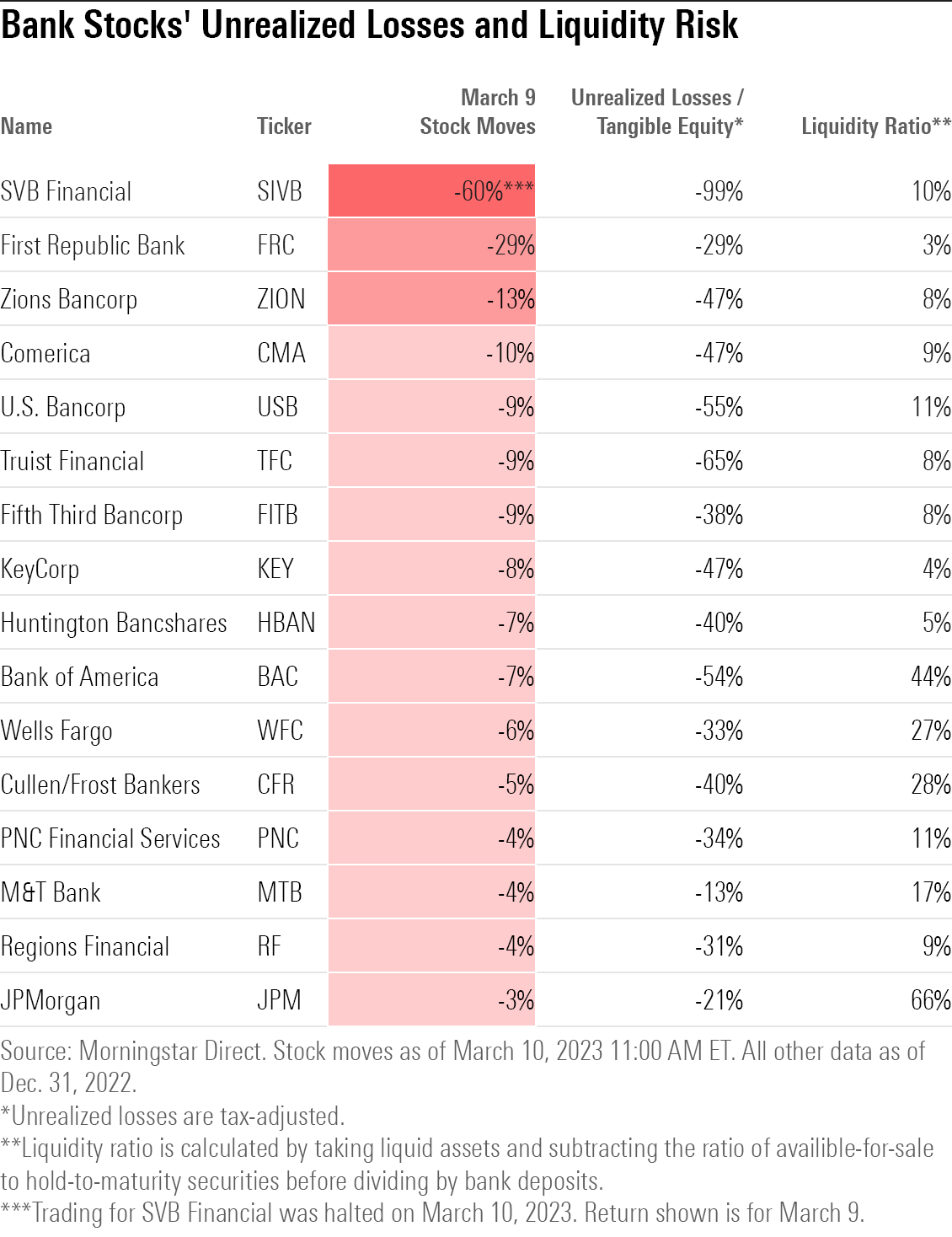
Correction (March 10, 2023): An earlier version of the article showed incorrect data in the “Bank Stocks’ Unrealized Losses and Liquidity Risk” table for the Unrealized Losses/Tangible Equity and Liquidity Risk columns. This has been corrected.
|
Sources 2/ https://www.morningstar.com/articles/1143298/bank-stock-selloff-triggered-by-svb-financial-liquidity-crunch The mention sources can contact us to remove/changing this article |
[ad_2]