
[ad_1]
Cytalux (pafolacianince), a drug that binds to cancerous tissue in the ovary and glows when exposed to fluorescent light, has been approved by the United States Food and Drug Administration (FDA) to help surgeons detect ovarian tumors during surgical procedures in female patients.
A Purdue University spokesperson told Fox News that Philip Low, a Purdue University presidential researcher for drug discovery, invented the drug. Moo described in a press release that when a surgeon turns on near infrared light during the operation, “these lesions light up like stars in a night sky”.
“While many surgeries result in complete resection of all cancerous tissue, a substantial fraction unfortunately leaves buried or hidden tumor tissue behind, often resulting in cancer recurrence and sometimes even death,” Low told Fox News.
EXPERIMENTAL DRUG INCREASES IMMUNOTHERAPY TREATMENT FOR PANCREATIC CANCER IN MICE
He added: “To help prevent these latest findings, we have designed a cancer-targeting fluorescent dye that specifically harbors cancer cells that express a folate receptor and cause them to fluoresce when illuminated with near infrared light. “
Low explained that cancer cells need folate, a B vitamin, to divide quickly, so he invented the drug that labeled a folate compound with a fluorescent dye. The drug is administered intravenously to a patient before surgery.
Washington, DC, USA – January 13, 2020: FDA sign at its headquarters in Washington DC. The Food and Drug Administration (FDA or USFDA) is a federal agency of the United States.
“Cancer cells have a huge appetite for this vitamin,” Low said in the release, “and we exploited their craving for folic acid by attaching a fluorescent dye to it.”
Low told Fox News that when the lighting occurs, the surgeon can locate and resect any malignant lesions that he may have overlooked during the operation.
A spokesperson for the University of Pennsylvania Health System told Fox News that while Purdue’s Phil Low synthesized the drug, researchers at the school were lead investigators in Phases 1, 2 and 3 of the trials and found promising results. Dr Sunil Singhal, along with colleagues at the Center for Precision Surgery at the Abramson Cancer Center at the University of Pennsylvania in partnership with On Target Laboratories, ran one of the nation’s largest clinical trial sites for Cytalux, according to the spokesperson.
FDA TO REVIEW UNPROVED CANCER DRUGS AFTER 10 YEARS OF DIFFERENCE
“By using a fluorescent dye that binds to cancer cells, making them glow during surgery, surgeons can identify and resect as many tumors from a patient as possible and improve prognosis,” Singhal, director of the Center for Precision Surgery at Abramson Cancer Center at the University of Pennsylvania said in release.
In the randomized, multicenter phase 3 study, 134 adult women who received Cytalux intravenously before surgery were evaluated under both fluorescent light and normal light. The release said that in the group, 27% had at least one cancerous lesion detected that was not discovered by standard sight or touch inspections during surgery.

University researchers said this new technology provides surgeons with a guide that goes beyond what is seen with the naked eye or by touch, especially when the lesions are small, according to the release. They also said it would help surgeons remove cancerous tissue more precisely, while sparing the removal of healthy tissue. The newly approved dye also helps detect cancerous lymph nodes.
“Illumination of cancer, which helps identify lesions that may be difficult to find, especially in the presence of scar tissue or other organic lesions, allows for more complete identification and surgical removal of cancer that may have been missed.” otherwise, ”Janos L. Tanyi, principal investigator at the University of Pennsylvania clinical trials site for phase 2 and phase 3 studies, said.
CLICK HERE TO GET THE FOX NEWS APP
Tanyi, who is also an associate professor of obstetrics and gynecology at the university’s Perelman School of Medicine, also said this new FDA approval would hold promise for improved outcomes in cancer patients. of the ovary, which face a high risk of recurrence after initial treatment. .
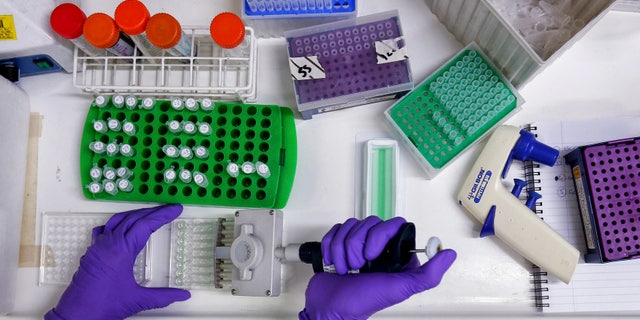
A scientist prepares protein samples for analysis in a laboratory at the Institute of Cancer Research in Sutton.
(Reuters)
Investigators said in the statement that only 20% of ovarian cancers are detected early because they are either asymptomatic or the symptoms mimic common gastrointestinal, bladder or bowel problems. By the time most women are diagnosed, investigators said the disease had advanced and most patients needed surgery to remove the tumors along with chemotherapy, according to the report.
Cytalux is the first fluorescent tumor targeting agent for ovarian cancer approved by the FDA.
On Target Laboratories will release the drug under the brand name Cytalux.
|
Sources 2/ https://www.foxnews.com/health/fda-approves-glowing-tumor-drug-to-help-surgeons-identify-ovarian-cancer-cells The mention sources can contact us to remove/changing this article |
[ad_2]