
[ad_1]
Sheena Patel looked as if she was working in the hot zone.
The Teton Raptor Center’s acting avian care director donned a white, full-body Tyvek suit, goggles and a mask to protect herself from any chance of contracting highly pathogenic avian influenza. The possible host: A dead bald eagle she was retrieving from the South Park Wildlife Habitat Management Area south of Jackson.
Sporting the apocalyptic-looking getup, she said, “I do like that I’m not in public doing this.”

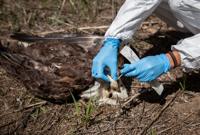
Sheena Patel collects samples from the carcass of a bald eagle to determine whether it died from avian flu.
Then she slapped on a pair of surgical gloves before crouching down to take an oral and cloacal swab from the dead raptor.
Avian influenza poses little risk to humans. People who contract it can expect to suffer from flu-like symptoms, but recover.
Not so for birds. Except for some waterfowl that can carry the disease asymptomatically, it causes sudden death. After experiencing disorientation and other symptoms reminiscent of lead poisoning, entire flocks, wild and domestic, can drop dead in 24 to 72 hours. Their lives can be extended with reactive care, but death is all but guaranteed, so wildlife clinics and animal hospitals generally don’t bother treating avian patients that exhibit symptoms. With few options, and limited time to act to keep the virus from spreading to other patients in clinical settings like the Teton Raptor Center, that means some birds are put down before veterinarians and wildlife hospital staff can confirm whether they are HPAI-positive or not.
That’s stressful for staff like Patel.
“There are so many cases that we have to euthanize just based on suspicion,” she said.


Patel loads a trash bag containing the remains of a bald eagle into the back of a Teton Raptor Center van after removing the dead bird from an elk corral. She anticipates continuing to pick up dead birds while the avian flu continues.
The Raptor Center has gone into the field 11 times to take samples from dead birds. Six have come back positive. Patel suspects the center will get one more positive result back in coming weeks for a red-tail hawk she recently tested and euthanized out of suspicion. So far, two of the birds that the Raptor Center has euthanized have been positive. One — a Swainson’s hawk — was not. But Patel said its injuries likely would have meant it would have met the same fate. She’s still awaiting results for the red-tailed hawk. In the meantime the Raptor Center is continuing to lock things down. It has set up a quarantine zone for newly admitted birds, which aren’t allowed into the clinic without registering a negative test.
For Executive Director Amy McCarthy, that all feels oddly familiar.
“We’ve gone from one pandemic to another,” she said.
‘Grossly under-reported’
Nationwide, avian influenza has affected some 38 million domestic birds, most of which were killed after animals in backyard or commercial flocks tested positive. But this year, wildlife health specialists and veterinarians say that, anecdotally, the bird flu seems to be having a greater impact on wild birds than it has in the past. That’s particularly true of raptors that eat asymptomatic waterfowl that carry the disease. The virus has even been detected for the first time in wild turkeys, including in Wyoming where over 30% of the wild birds with confirmed cases of highly pathogenic avian influenza — 13 in total — have been wild turkeys.
State Wildlife Veterinarian Sam Allen said officials knew the bird flu was coming for Wyoming’s wild flocks after it killed 5,000 cranes in Israel last year. Migratory wild birds move the virus from continent to continent as they travel, shedding it along their flyways, so it was only a matter of time before it showed up in the United States. But Allen said people are generally bad at preventive measures, preferring to react.
“I also don’t think we knew it was going to be this hard on wild birds in North America,” Allen said. She doesn’t have population numbers to effectively evaluate how hard “hard” is.
But Allen said that the state wildlife health lab, where she works, has anecdotally seen significantly more confirmed cases of highly pathogenic avian influenza than in 2015.
“We have never had, from 2014 to now, the number of birds coming in with highly pathogenic avian influenza,” Allen said.
She estimated that the lab has processed around 100 samples. The Animal and Plant Health Inspection Service, which reports avian influenza cases in domestic and wild birds at a county level, reported that 43 total birds had come back positive in Wyoming by Tuesday. That’s a bit of a lagging indicator — Patel said the Raptor Center had received confirmation for an additional case beyond the five that APHIS was reporting Tuesday in Teton County — but indicative of the direction Wyoming’s heading with its wild birds.
Some people, like Jackson Hole veterinarian Dan Forman, who previously sat on the Teton Raptor Center’s board, think that’s likely an undercount.
“That is grossly under-reported,” Forman told the Teton District Board of Health on Tuesday morning. “There’s lots of birds that die that we don’t know about in the wild.”
Allen couldn’t say how much time, exactly, her staff has spent handling bird flu. But she did say it’s been constant for the past month, time spent in relatively unpleasant ways.
“A lot of the people in my lab have been working on weekends, taking calls from the public,” she said. “We’re all euthanizing birds ourselves.”
Allen said the disease’s global spread is a concern. When the bird flu wanes in one part of the globe, it could pop back up in another as birds migrate. There’s also the small chance of it spreading to humans who inadvertently touch a dead bird or come into contact with fecal matter. And there have been impacts to the poultry industry. Farmers in the Midwest have had to destroy millions of chickens, driving up egg and meat prices, and hurting consumers already dealing with inflation.
But Wyoming has, for now, avoided the sort of massive commercial killings that Midwestern farmers have undertaken. Once bird flu hits a chicken flock, for example, the birds are all expected to die within days. Killing the birds is intended to limit the spread of disease and animal suffering.
Assistant State Veterinarian Brad DeGroot, who focuses on livestock rather than wildlife, said part of the reason Wyoming has been spared is because it doesn’t have commercial poultry operations as large as those in the Midwest. But he said the number of disease-carrying waterfowl that migrate through the Equality State is also significantly less than its western neighbors.

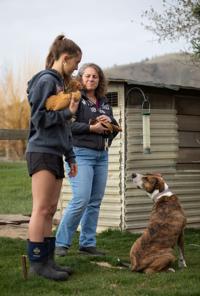
Gigi, left, and Ginny Mahood are taking measures to protect their chickens from the deadly avian flu. For now the family’s birds remain quarantined in their coop to minimize the risk of infection from other birds in the area.
“There are just several — maybe even more than several — orders of magnitude more [waterfowl] that cross those other states,” DeGroot said.
Still, Wyoming farmers have had to euthanize eight backyard flocks with 350 birds that were infected, according to APHIS data.
Ginny Mahood and her daughter, Gigi, who raise chickens to show at the 4-H livestock show, have so far been spared that fate.
“One of them was acting up a little weird, so we separated her for a bit,” Gigi said. “None of them did anything.”
If the hen had bird flu, she and the rest of the flock would likely have dropped dead within three or four days. They didn’t. So Gigi reunited the hen with its coop mates when it was looking better.
“We just figured it’s just either molting or just a cold,” Gigi said.
The Mahoods have also been careful to protect their flock. They’ve installed deer fencing around the perimeter to keep out the black songbirds that used to get into the chicken feed. And they’ve stopped letting the hens and roosters roam in the yard in the evening, an attempt to prevent them from inadvertently stumbling on some other bird’s poop that could transmit the virus. That has the hens cooped up and the roosters feeling a little less frisky. The family isn’t expecting any fertilized eggs this year.


The Mahood family’s chickens normally would be allowed time to roam the family’s backyard, but the deadly virus is keeping them in lockdown for now. Chickens are especially susceptible to the avian flu.
DeGroot said the Mahoods could take precautions a step farther: By wearing different coveralls and shoes when working with the birds to prevent transmission via fecal matter.
Forman said Tuesday that’s an important step towards keeping backyard flocks safe. Owners, he said, want their birds to “roam free.”
“That’s a really big problem,” Forman said. “Why? Because of wild birds.”
That’s especially true when wild birds congregate around feed for domesticated flocks, and mingle with the birds. DeGroot, the assistant state vet for livestock, said that there’s been mortality events when livestock owners allow their chickens to run with domesticated ducks and waterfowl. The ducks, he thinks, draw in wild waterfowl. And the chickens suffer.
“What we think is happening is the ducks draw in the wild waterfowl, the wild waterfowl hobnob with the domestic waterfowl and then the domestic waterfowl carry the virus to the chickens,” DeGroot said. “The ducks and geese, for them it’s just another day. But the chickens around them are dying like flies.”
DeGroot also recommended separating gallinaceous birds like chickens, turkeys, guinea fowl and peafowl from waterfowl generally. If they do that, DeGroot recommended caring for waterfowl first, then chickens.
Wild birds, however, aren’t so good at staying apart from one another, both socially and as predators.
“It’s really common in flocking birds,” Patel said of avian influenza. “Less than 6 feet, not socially distancing, that kind of thing.”

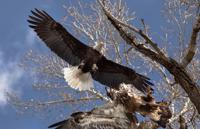
A juvenile bald eagle leaves its perch as an adult eagle claims the spot for its own in March along South Park Loop Road. Federal officials reported Tuesday that avian influenza had killed at least 80 bald eagles nationwide, including one in Park County. No dead bald eagles deaths have been tied to avian flu so far in Teton County.
But those smaller birds’ unassuming negligence on the distancing front goes up the food chain. Raptors, like owls and red-tailed hawks, that eat smaller waterfowl can ingest the virus when they dig into their kill. Eleven of the confirmed cases in Wyoming raptors are in great-horned owls. Patel and Allen said that’s likely because the large strigiformes are good at what they’re evolutionarily designed to do.
“They’re just really great apex predators,” Patel said. “They can take down large prey. They can take down a duck easily, whereas a smaller raptor may not be able to do that.”
But Allen and Forman wondered whether owls are showing up in higher numbers because they’re beloved creatures — and fairly large.
“If you’re going to walk into the field and you’re looking for dead raptors and owls versus dead chickadees, what are you going to find first?” Allen said.
Allen wasn’t sure, however, why turkeys are falling prey to the virus this year when they’ve escaped it before. Technically, corvids like magpies are considered songbirds and three of them have tested positive in Wyoming thus far, including two in Teton County. But other songbirds haven’t made the list so far. Allen couldn’t say why exactly that was. But Patel wondered whether it had to do with the smaller birds’ behavior. Generally they interact less with virulent waterfowl that are causing a lot of the problems.
“A lot of red-tailed hawks, great horned owls, eagles are often preying upon waterfowl, they’re just big targets for getting it,” Patel said. “Songbirds don’t have typically that much of an interaction with waterfowl.”
But Patel and Allen said that it “certainly is possible” for warblers and others to fall prey to the bird flu.

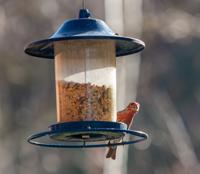
A house finch takes advantage of a residential bird feeder for a quick snack before flying away last week. The Teton Raptor Center is advising locals to remove bird feeders to reduce the spread of avian flu.
Officials are worried songbirds can carry bird flu as fomites — objects or materials capable of carrying infections — but think the smaller birds might not be as susceptible to the virus.
In the meantime, the Raptor Center is still recommending that people take down bird baths and bird feeders. Songbirds, Patel said, are still at risk. But the baths could also pose a risk to larger predatory raptors, especially if a hawk eats an infected duck and then goes to hunt at a bird feeder. Whether it’s successful, or just stops to take a bath in the bowl, that interaction could spread the disease.
“Especially since songbirds are flocking birds and hanging around each other more than raptors,” Patel said. “They’re not out of the woods. They’re still at risk.”
One type of bird hasn’t made the list yet in Wyoming: bald eagles. That includes the bird Patel picked up at the South Park Wildlife Habitat Management Area earlier in May.
That bird’s test came back negative, though APHIS reported Tuesday that avian influenza had killed at least 80 bald eagles nationwide, including one in Park County.
Patel said the Raptor Center doesn’t usually pick up dead birds. Dying is a part of the natural cycle and they prefer to leave dead birds to decay. But they’ve been busy doing so.
“We’re just testing everything and trying to get it out of the public areas to keep the community safe,” Patel said.
How much longer she’ll have to do that is unclear.
Patel said the Raptor Center thinks the current outbreak will subside in the next month or as spring migration comes to a close. But Allen said that, as with COVID, it’s hard to predict how the current outbreak will end. Most of the data used to make predictions comes from the 2015 outbreak, which looked different than the current one. So while that lasted about six months, she was hesitant to say how long the current outbreak would take to subside.
“I think there’s still a lot of question marks,” Allen said.

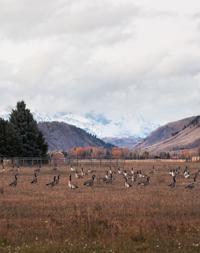
A flock of Canadian geese wander through the pasture along South Park Loop Road in November 2021. A number of geese have died from avian influenza this year, which wildlife officials say is abnormal. They typically carry the virus asymptomatically.
DeGroot said that the bird flu’s epidemiological curve started to peak in the first week of April and declined over the next few weeks. But he said it’s leveled off since then, at least in commercial flocks in which the number of infected facilities has fluctuated between 20 and 30 since the third week of April. DeGroot still thought that cases could drop off as summer progresses, either as migrating ducks move farther north or if the ducks gain some sort of immunity. But that’s a big unknown.
“Will they become solidly enough immune that they no longer shed enough virus to infect domestic poultry populations when they come in contact with them?” DeGroot asked. “Or will their immunity wane rapidly enough that they circulate this virus amongst themselves and continue to shed high enough levels of virus that infection remains a possibility?”
In the meantime, he expects the avian influenza to have a long tail, just like COVID-19.
And Patel will continue collecting samples from birds, doing her best to stomach what she finds. Even for someone who deals frequently with wild animals, the sight of the bald eagle was a bit much. But she took it in stride.
“Oh, there’s maggots in there,” Patel said, opening up the dead eagle’s mouth to swab its insides for viral matter. “Yum.”

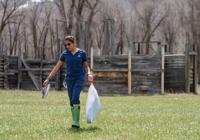
With a deceased bald eagle safely contained inside multiple trash bags, Sheena Patel returns to her vehicle to bring the raptor carcass to the Teton Raptor Center after collecting it from the South Park elk feed grounds.
.
|
Sources 2/ https://www.jhnewsandguide.com/news/environmental/from-one-pandemic-to-another-avian-influenza-hits-wild-birds/article_2c0f4581-bc93-54a3-86cd-8d9dd214b8b0.html The mention sources can contact us to remove/changing this article |
[ad_2]