
[ad_1]
Abstract and Introduction
Introduction
Approximately 12 million children and adolescents aged ≤18 years in the United States have been infected with SARS-CoV-2, the virus that causes COVID-19, since December 2019,* and COVID-19–associated hospitalization rates increased among children aged < 5 years during the B.1.617.2 (Delta) and B.1.1.529 (Omicron) variant peaks.[1] In June 2022, the Food and Drug Administration amended the Emergency Use Authorization for the BNT162b2 (Pfizer-BioNTech) COVID-19 vaccine to include use of the vaccine in children aged 6 months–4 years and mRNA-1273 (Moderna) for children 6 months–5 years, which CDC recommends all children receive.† Advance reports indicated that fewer than 50% of parents were willing to vaccinate their children aged <5 years.[2,3] Using the Pediatric Research Observing Trends and Exposures in COVID-19 Timelines (PROTECT)§[4] prospective cohort, changes in parental perceptions toward COVID-19 vaccines and vaccination¶ for children aged <5 years were examined during July 2021–May 2022. Among 393 parents who participated in a baseline survey, approximately 64%, 19%, and 10% reported they were likely, were unsure, or were unlikely, respectively, to have their child aged <5 years receive the COVID-19 vaccine. The odds of parents intending to vaccinate their child was lower 3 months after the baseline survey, (adjusted odds ratio [aOR] = 0.84, 95% CI = 0.6–1.0) than at baseline. During the same period, parents also were less likely to perceive that COVID-19 vaccines were effective (aOR = 0.61, 95% CI = 0.4–0.8) and safe (aOR = 0.65, 95% CI = 0.5–0.9) compared with baseline . Intent to vaccinate and perception of safety increased 6 months after the baseline survey in unadjusted models (OR = 1.66, 95% CI = 1.1–2.5; and OR = 1.82, 95% CI = 1.3–2.6, respectively), but were no longer significant after adjusting for the child's receipt of a positive SARS-CoV-2 test result before survey completion, age, sex, race and ethnicity, health insurance, and study site. Enhanced efforts to address parental confidence in childhood vaccination and increase vaccination coverage among children <5 years are needed, including aged reinforcing the effectiveness and safety of vaccination against COVID-19.
PROTECT is an ongoing prospective cohort that includes >2,300 children and adolescents aged 4 months–17 years; the study monitors infections with SARS-CoV-2 in Arizona, Florida, Texas, and Utah.[4] Children were recruited via community outreach from the public and from families participating in the HEROES-RECOVER longitudinal cohorts of essential and frontline workers.[5,6] Upon enrollment, parents provided sociodemographic information, COVID-19 illness history, vaccination history, and their perceptions about COVID-19 vaccines for children. Participants are surveyed every 3 months. SARS-CoV-2 infections are identified among participant children through midturbinate nasal specimens collected weekly and tested via reverse transcription–polymerase chain reaction. Parents who completed the baseline survey and at least one follow-up survey were included in analysis. One child was randomly selected from households with two or more children aged <5 years to avoid household clustering. This study was restricted to 393 children aged <5 years who were enrolled in the PROTECT study during July 2021–May 2022. Vaccine intention was ascertained using baseline parental responses to the question, "What are the chances that [child] will get a COVID-19 vaccination?" Responses were grouped into three categories: unlikely (almost zero chance, very small chance); unsure (small chance, do not know, moderate chance); and likely (large chance, very large chance, almost sure).
A generalized estimating equation (GEE) model was used for each question to evaluate whether within-parent responses changed from a neutral or negative response (unsure or unlikely) to a positive response 3 and 6 months after the baseline enrollment survey. All available surveys from participants in the analytic group were included in the GEE models. The survey time point was added as a categorical predictor to calculate the OR for vaccine intention and vaccine perceptions. In addition, ORs describe the likelihood of all participants providing more positive responses at the 3-month and 6-month surveys compared with the baseline survey. Both unadjusted and adjusted models were calculated; the adjusted model included a positive test for SARS-CoV-2 infection in the child between surveys, sociodemographic characteristics, and study site. For vaccination intention outcomes, GEE models with multinomial distributions and cumulative logit links were used; the other models assessing perception outcomes used binomial distributions and logit links. All statistical analyzes were completed using SAS (version 9.4; SAS Institute); statistical significance was defined as p<0.05 for chi-square tests and nonoverlapping 95% CIs for GEE models. PROTECT was reviewed by CDC and approved by the Institutional Review Boards at University of Arizona and Abt Associates under reliance agreements; the study was conducted consistent with applicable federal law and CDC policy.**
During July 2021–May 2022, parents provided information on 393 children aged <5 years enrolled in the PROTECT study (Chart 1). The majority of children (227; 58%) resided in Arizona, and 92 (23%) had parents in the HEROES-RECOVER cohort.[5,6] Median age was 2.8 years (SD = 1.3 years); 189 (48%) were male, 183 (47%) were non-Hispanic White persons, and 110 (28%) were Hispanic persons; 132 (34%) children received a positive SARS-CoV-2 test result during the study. At baseline, 253 (64.4%) parents reported that they were likely to get their child vaccinated; 76 (19.3%) were unsure, and 39 (9.9%) reported that they were unlikely to vaccinate their child (Chart 1). There were statistically significant differences in vaccine intention identified by study site (p<0.001), positive SARS-CoV-2 test result during the study (p = 0.006), percent of household members vaccinated (p = 0.011), and household income ( p = 0.003).
Approximately two thirds of participants (270; 68.7%) completed a 3-month survey and 137 (34.9%) completed a 6-month survey (Chart 2) (Figure). Among parents who completed a 3-month survey, 11 (4.1%) changed their vaccination intent from a neutral or negative to positive response after 3 months, although parents overall were 24% less likely to vaccinate (aOR = 0.76) than they were at baseline. Also at 3 months, 30 (11.2%) parents changed their perception of vaccine effectiveness from neutral or negative to positive, although overall, they were 39% less likely to perceive the vaccine as effective (aOR = 0.61). At 3 months after the baseline survey, perception of vaccine safety changed from neutral or negative to positive for 29 (10.9%) parents; however, overall parents were 35% less likely to perceive the vaccine as safe (aOR = 0.65). When asked about perceived trust in government, 28 (10.7%) of parents changed from a negative or neutral to a positive response after 3 months, although they were 51% less likely to report trust in the government compared with baseline (aOR = 0.49) .
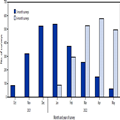
Fig.
Distribution of 3-month and 6-month surveys, by study month — Pediatric Research Observing Trends and Exposures in COVID-19 Timelines cohort, four states, October 2021–May 2022
Among 137 parents who completed a 6-month survey, 11 (8.1%) changed their perception of vaccine effectiveness from neutral or negative to positive (Chart 2); overall parents were 62% less likely to have a positive response (aOR = 0.38) regarding vaccine effectiveness. Eleven (8.4%) parents changed their level of trust in government from negative or neutral to positive, although overall, parents were 49% less likely to have a positive response (aOR = 0.51). In unadjusted models only, vaccination intent and perceptions of vaccine safety were less likely to be neutral or negative at 6 months (OR = 1.66 and OR = 1.82, respectively); after adjusting for receipt of a positive SARS-CoV-2 test result before 6-month survey completion, age, sex, race and ethnicity, health insurance, and site, these were no longer statistically significant.
.
|
Sources 2/ https://www.medscape.com/viewarticle/980305 The mention sources can contact us to remove/changing this article |
[ad_2]