
[ad_1]

A new study provides the first empirical evidence of SARS-CoV-2 transmission via people’s hands and frequently touched household surfaces.
Research led by Imperial College London sheds new light on the spread of COVID-19 in households, where most SARS-CoV-2 transmissions occur, and it is the first to link the presence of SARS-CoV-2 in the hands of people and frequently household surfaces in contact with risk of infection among contacts. The results support the use of home interventions when a person has an infection, especially frequent hand washing, regular disinfection of surfaces, And physical distancing as well as the use of masks to curb the spread of COVID-19.
The study of 279 households in London, Posted in The lancet microbe, was conducted at the height of the pandemic during the alpha and pre-alpha waves. The research was conducted at Health Protection Research Unit (HPRU) of the National Institute for Health and Care Research (NIHR) in the field of respiratory infectionsa research partnership between Imperial College London and the UK Health Security Agency (UKHSA).
Professor Ajit Lalvani, lead author of the study and director of the NIHR HPRU in respiratory infections, said: “There is no doubt that if you have COVID-19, you are emitting the virus into the air in the form of micro-aerosols as well as large droplets that land on your hands and the surfaces around you. What has not been shown, so far, is that the presence of the virus on people’s hands or on household surfaces predicts transmission to contacts.
“Our real-life study in London households provides the first empirical evidence showing that the presence of SARS-CoV-2 on people’s hands and surfaces contributes significantly to the spread of COVID-19. As we have not systematically sampled the air of dwellings, we cannot exclude the possibility of parallel airborne transmission.
“In homes where we found the virus on surfaces and on participants’ hands, infection among contacts, and therefore transmission, was significantly higher.” Nieves Derqui School of Public Health
The first study of its kind – conducted by researchers from Imperial College London, UKHSA and the University of Oxford – prospectively recruited 414 susceptible household contacts living in the same households as 279 newly diagnosed primary cases between August 1, 2020 and March 31, 2021. Since the study was conducted early in the pandemic, very few had been vaccinated or previously infected and the majority were therefore non-immune and susceptible to infections. This allowed researchers to rigorously assess risk factors and vectors of transmission under unique circumstances similar to a natural experiment. The age range was 6 to 79 years old and 52% were women.
All contacts were routinely tested for SARS-CoV-2 infection by PCR on nose and throat (upper respiratory tract (URT)) swabs.
The researchers also took swabs from primary case’ and the hands of the contacts as well as the most frequently touched surfaces in common areas (e.g., fridge and kettle door handles, kitchen faucets, etc.) to measure SARS-CoV-2 genetic material (RNA) and virus particle counts. The researchers looked for correlations between microbiological detection of the virus on hands and surfaces and transmission to household contacts.
Nieves DerquiFirst author of the study, from the NIHR HPRU in Respiratory Infections at Imperial College London, said: “In the homes in which we found the virus on the surfaces and hands of participants, infection among contacts , and therefore transmission, was significantly higher.”
Increased risk of infection
After taking into account other potentially influential factors such as gender, vaccination status, underlying illnesses, and contact relationship to the primary case, the researchers found that if the virus was detected on the hands of the cases primary, contacts in their household were 1.7 times more numerous. likely to be infected than those in households where the primary cases did not have the virus on their hands.
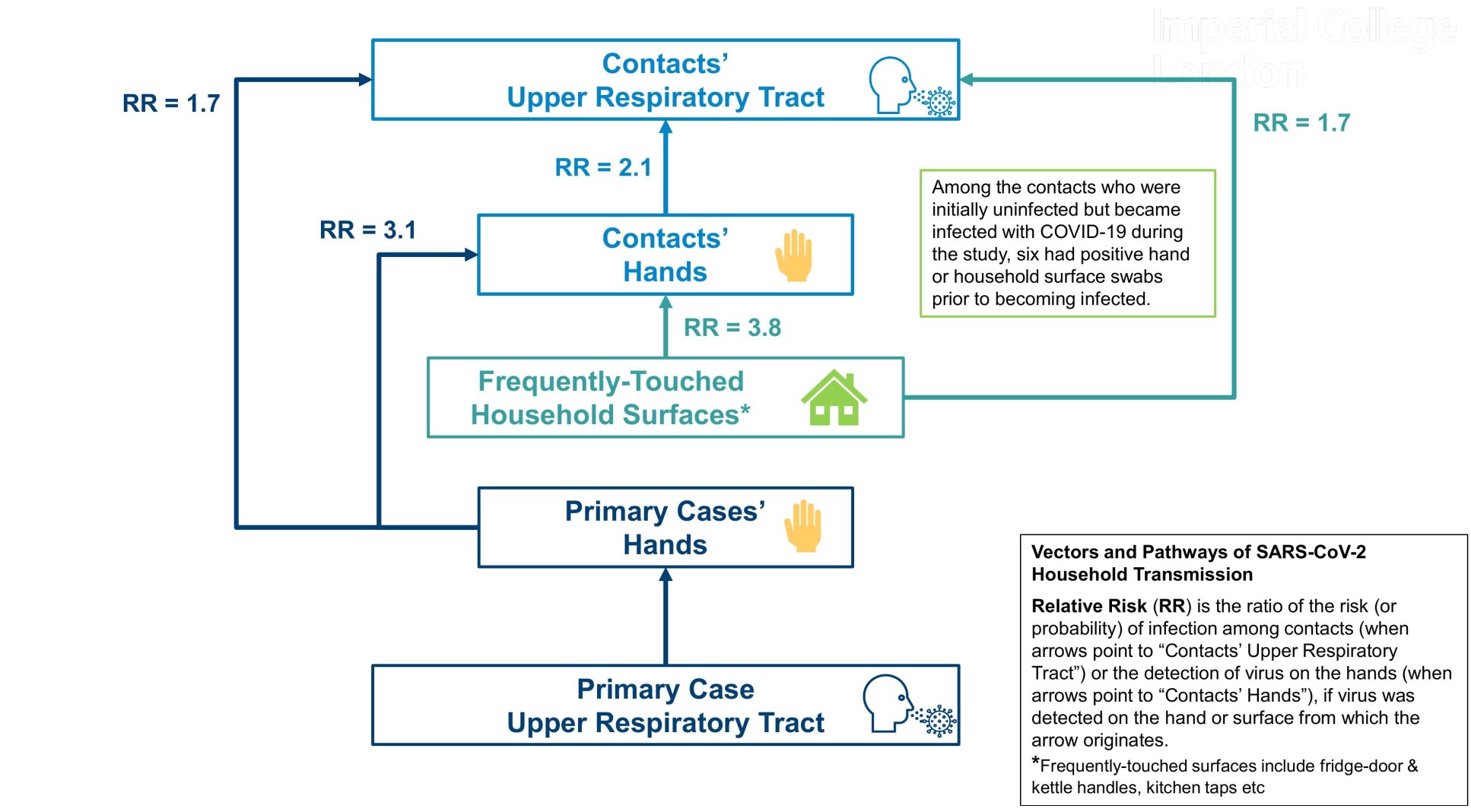
Similarly, having the virus on the hands of primary cases was associated with a three times higher risk of contacts in the household having a positive swab, and in turn, contacts with the virus on their hands were twice as likely. to be infected with COVID 19.
If the virus was present on frequently touched surfaces in the household, contacts were 3.8 times more likely to have detectable virus on their hands and 1.7 times more likely to be infected, i.e. say to have a PCR-positive URT swab.
“Our data strongly suggest that in addition to frequent hand washing, decontamination of frequently touched surfaces could prevent transmission.” Professor Ajit Lalvani National Heart and Lung Institute
Of the contacts who were initially uninfected but became infected with COVID-19 during the study, six had positive household hand or surface swabs prior to becoming infected. This confirms the directionality of transmission from household surfaces and hands from contacts to their nose and throat.
Whole genome sequencing of the 25 primary cases and their respective contacts where possible confirmed that each primary case-contact pair was infected with the same strain of SARS-CoV-2, confirming familial transmission between the primary cases and their respective contacts.
Professor Lalvani said: “My team’s herculean logistical enterprise under the difficult circumstances at the height of the pandemic in real-life households strongly supports the theory that transmission of SARS-CoV-2 from surfaces and hands contamination occurs in households. With successive new variants likely to spread widely despite booster vaccinations, the simple and easily applicable public health interventions and messages backed by our evidence are a valuable, safe and timely addition to the toolkit for safe living. safety with COVID-19.
“Our new understanding of household transmission routes now allows us to prioritize simple measures to interrupt the spread of the virus. Our data strongly suggest that in addition to frequent hand washing, decontamination of frequently touched surfaces could prevent transmission.
Despite the important findings, the researchers note that this is an observational study and as such cannot prove causation. Moreover, as the air in homes was not systematically sampled, airborne transmission cannot be excluded.
They also acknowledge that non-white ethnicities and older age groups were underrepresented in the study and that their results were limited to the pre-alpha and alpha variants, so the results may not apply to other groups or to more recent and infectious variants.
The study was funded by the National Institute for Health and Care Research – Health Protection Research Unit in Respiratory Infections.
‘Risk factors and vectors for domestic transmission of SARS-CoV-2: a prospective longitudinal cohort study‘ by Nieves Derqui et al. is published in the journal The lancet microbe.
Main image credit: Shutterstock.
|
Sources 2/ https://www.imperial.ac.uk/news/244251/covid-19-spread-households-linked-virus-hands/ The mention sources can contact us to remove/changing this article |
[ad_2]