
[ad_1]
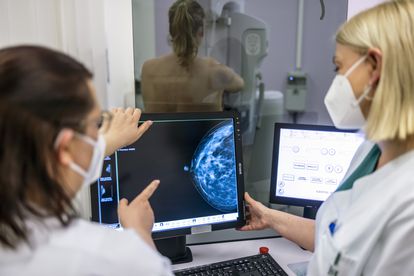
There are genetic mutations that predispose a person to breast cancer. Other risk factors include a family history of the disease, obesity, and unhealthy habits like smoking. While most people are aware of these risks, having dense breasts goes unnoticed. A study published in the journal JAMA revealed that few women perceive this variable as a risk factor and know little or nothing about it. Breast density has nothing to do with breast size; it is about the internal composition: that is to say breasts with more fibrous and glandular tissue than fatty tissue. For women with extremely dense breasts, this difference increases the risk of developing a tumor, making it up to four times higher.
Breast density is not visible to the naked eye. Only a mammogram can reveal it, explains Javier de Santiago, president of the gynecological oncology section of the Spanish Society of Gynecology: “The breast is made up of fibroglandular tissue and fat. When the first predominates, we speak of a dense breast. But that has nothing to do with size. In fact, generally, small breasts are more dense. Young people are also more likely to have dense breasts. However, breast density is not a fixed characteristic; this can change over a woman’s lifetime due to different factors, such as chronological age, the scientists explain. According to de Santiago, who is also director of gynecology at MD Anderson, 50% of women have dense breast tissue.
According to JAMA article, a qualitative study of women aged 40 to 76, comparing various risk factors and the risk associated with breast density, 93% of participants believed that a family history of breast cancer posed the greatest risk, and 65% thought being overweight or obese posed a greater risk than breast density. “Of 61 women surveyed, few women perceived breast density as contributing to their risk of developing breast cancer,” the researchers noted. But it is not because this variable is poorly understood by patients that the scientific community ignores it or that it is not taken into account in examinations.
One of the reasons for the greatest danger is that a dense breast can hide a tumor in mammography, explains Marina Alvarez, spokesperson for the Spanish Society of Medical Radiology: “Mammography is a variant of radiography. The picture is in black and white; fat is seen in black and glandular tissue and tumor are in white”. Because they are the same color, a dense breast can make a malignant lump go unnoticed. “This can make diagnosis difficult. The more fibroglandular tissue there is, the more difficult it is to see a lesion in the breast,” admits the radiologist.
Breast density is also a risk factor in itself, although the scientific community is unsure why this is the case. According to Xavier Castells, head of epidemiology at Hospital del Mar in Barcelona, this is probably because “the percentage of breast tissue in the chest is higher and there is a greater possibility of tumor. “It has been said that a woman with higher breast density is twice as likely to get cancer than a woman with less dense breasts,” explains the epidemiologist.
Interactions between risk factors
Experts point out that there are different levels of density. In fact, the JAMA A study warns that dense breast tissue is associated with a 1.2 to four times higher risk of breast cancer, depending on the degree of density. Radiologists measure all of this, says Alvarez: “The information from a mammogram is very standardized and the first thing we look at is the density, but there are four different types. [A, B, C, D, from the lowest to highest level of density]. We also look to see if there are any findings, which may be a nodule or calcification, and describe them. We use a tool to rank the risk of malignancy: level one [means] no malignancy, [while] level five is highly suspicious and level six is confirmed malignancy, for example.
In any case, breast density alone cannot be interpreted as an isolated risk factor. It must be contextualized by considering other risk variables, such as age, family history and genetic predisposition. Everything counts, and it adds up. “Patients should not be alarmed. It’s not about reading mammograms now. The ideal is to study what other factors may also exist in order to carry out a specialized follow-up,” explains De Santiago.
According to Castells, age and interactions between different risk factors are important: “If you have a benign proliferative lesion, in four years, the risk of cancer is more than double that of women who do not have one. And if you add family history, the risk is seven times higher. And if you also have dense breasts, the risk is 15 times higher,” he explains. But, he warns, this level of risk must also be contextualized: “The woman most at risk has 7% [risk]. Ninety-three percent won’t get cancer. In other words, the probability is low.
Castells says having BRCA gene mutations, which are closely linked to cancer risk, is a very important factor. Similarly, depending on age and family history, having two or more risk factors “may also outweigh any other factor,” he observes. A history of benign lesions is another risk factor, but it strongly depends on the type of lesion. “Breast density is also a factor, because it can double the risk, but ultimately the absolute risk is not very high,” he argues.
A more personalized screening
The role of breast density has opened a debate about the effectiveness of traditional breast cancer screening in patients with dense breasts. In Spain, early detection tests are in place for women aged 50-69, who are encouraged to have a mammogram every two years, but experts agree that more specific follow-up might be appropriate for this. band. “In very dense breasts, screening should be done by MRI and not by mammography. This would help detect more tumors and there would be fewer interval carcinomas [the name given to tumors diagnosed in the period between screening rounds]Alvarez says. In these cases, MRI is a more reliable method, but also more invasive because it requires the administration of intravenous contrast and there is also a risk of false positives, with all the stress and impact that this can generate for the patient.
Alvarez says this topic is being debated in Europe and there are different proposals on the table. One suggestion is to alternate between mammography and contrast-enhanced MRIs at each round of screening. Another option is to use a different technique like tomosynthesis which, instead of taking one type of picture like mammography does, records many pictures in millimeter slices: “For the patient, it’s like a mammogram: the sensation is the same, and it takes the same time. A recent study concluded that this technique “is particularly beneficial for women with denser breast tissue.”
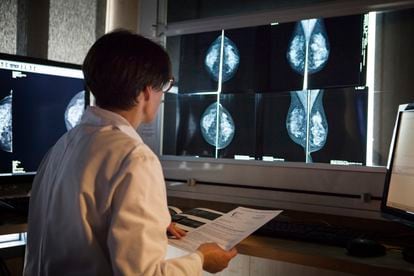
For now, however, the protocol has not changed. “In general, women with dense breasts are treated the same as everyone else. No other tests are performed. Usually when a woman is referred for further testing, something has been found; it’s not just because of the breast density,” explains the radiologist. Indeed, Castells believes that the approach for women with dense breasts or other risk factors needs to change and move towards “personalized screening.” He observes that “everyone does not have the same risk and those who have more [of a risk] should be examined more intensively.
The epidemiologist adds that an individual decision, a specific case to be assessed between the doctor and the patient, is not the same thing as population screening, which must be guaranteed for an entire target population: “We have the infrastructure, but the problem is that radiologists have to be trained to know how to read it and the response takes longer. We now call five million women in Spain every two years. 30% [of them] have a high density [breasts]. And bringing in 1.5 million women for tomosynthesis isn’t easy.
Communicate with patients
In about 30 US states, healthcare professionals are required to tell patients about their breast density when they undergo a mammogram. The experts we consulted admit that this is not usually done in Spain. As to whether it would be a good idea to impart that knowledge to the patient, Castells says “the easy answer is…yes,” but that information needs to come with something else, he adds. “At the same time that you tell them that they have more risks, you should offer them a way out, a proposal. What are you doing [say to] them?”
Montserrat Rué, a researcher in the Department of Basic Medical Sciences at the University of Lleida, advocates improving communication with patients. “Women want to know; they appreciate you giving them information. And having a risk factor doesn’t mean something will happen to you. It is when several factors come together that closer monitoring is necessary,” explains Rué. Her research has focused on women’s perception of screening and its potential risks. The scientist admits that there is a tendency to “overestimate the risk and underestimate the consequences of diagnostic tests”, as overdiagnosisfalse positives or false negatives.
Rué advocates shared decisions between doctors and patients, creating “instruments and materials that explain the risk and help people…understand” this danger. She adds that “in general, people think that we are more exposed to these diseases than we really are. A woman’s lifetime risk of breast cancer is 12%. The fear that comes from having [people] close to us who have had [the disease] is contagious.
Subscribe to our weekly newsletter to get more English news coverage from EL PAÍS USA Edition
|
Sources 2/ https://english.elpais.com/science-tech/2023-04-15/how-breast-density-influences-breast-cancer-risk-it-can-hinder-diagnosis.html The mention sources can contact us to remove/changing this article |
[ad_2]