
[ad_1]
Chronic wounds are a major health problem for diabetic patients and the elderly – in extreme cases they can even lead to amputation. Using electrical stimulation, researchers from a project at Chalmers University of Technology, Sweden, and the University of Freiburg, Germany, have developed a method that speeds up the healing process, allowing wounds to heal three times faster.
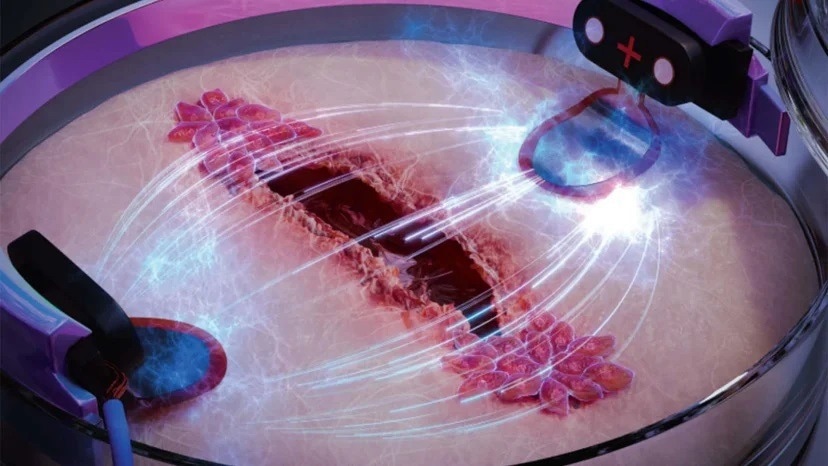
New research from Chalmers University of Technology and the University of Freiburg shows that wounds on cultured skin cells heal three times faster when stimulated with an electric current. The project has recently secured additional funding so that the research can get a little closer to the market and the benefit of patients. Image Credit: Chalmers University of Technology
There’s an old Swedish saying that you should never neglect a small injury or a friend in need. For most people, a small wound does not lead to serious complications, but many common diagnoses make healing much more difficult. People with diabetes, spinal injuries or poor blood circulation have impaired healing ability. This means a greater risk of infection and chronic wounds – which, in the long term, can lead to consequences as serious as amputation.
Now a group of researchers from Chalmers and the University of Friborg have developed a method using electrical stimulation to speed up the healing process.
“Chronic wounds are a huge societal problem that we don’t hear much about. Our discovery of a method that can heal wounds up to three times faster can be a game-changer for diabetics and the elderly, among others, who often suffer a lot from wounds that don’t heal,” says Professor Maria Asplund. Fellow in Bioelectronics at Chalmers University of Technology and responsible for research on the project.
Electrical cell guidance for faster healing
The researchers worked from an old hypothesis that electrical stimulation of damaged skin can be used to heal wounds. The idea is that skin cells are electrotactic, which means that they “migrate” directionally in electric fields. This means that if an electric field is placed in a petri dish with skin cells, the cells stop moving randomly and start moving in the same direction. Researchers investigated how this principle can be used to electrically guide cells to accelerate wound healing. Using a tiny technical chip, the researchers were able to compare wound healing in artificial skin, by stimulating a wound with electricity and letting one heal without electricity. The differences were striking.
We were able to show that the old electrical stimulation hypothesis can be used to accelerate wound healing. In order to study exactly how it works for wounds, we developed a kind of biochip on which we grew skin cells, in which we then made tiny wounds. Then we stimulated a wound with an electric field, which clearly led to its healing three times. as fast as the wound that healed without electrical stimulation.
Maria Asplund, Associate Professor of Bioelectronics, Chalmers University of Technology
Hope for diabetic patients
In the study, the researchers also focused on wound healing in relation to diabetes, a growing health problem worldwide. According to the World Health Organization (WHO) and the International Diabetes Federation, one in 11 adults today has some form of diabetes.
“We examined diabetic wound models and investigated whether our method could be effective even in these cases. We have seen that when we mimic diabetes in the cells, the wounds on the chip heal very slowly. However, with electrical stimulation, we can increase the speed of healing so that cells affected by diabetes almost match healthy skin cells,” says Asplund.
Individualized treatment the next step
Chalmers researchers recently received a major grant that will allow them to continue their research in the area and, in the long term, develop consumer wound healing products on the market. Similar products have already been released, but more basic research is needed to develop effective products that generate sufficient electric field strength and stimulate in the right way for each individual. This is where Asplund and his colleagues come in:
“We are now looking at how different skin cells interact during stimulation, to get closer to a realistic wound. We want to develop a concept that allows us to “scan” wounds and adapt the stimulation to each wound. We believe this is the key to effectively helping people with slow-healing wounds in the future,” says Asplund.
Source:
Journal reference:
Shaner, S., et al. (2023). Bioelectronic microfluidic wound healing: a platform to study direct current stimulation of injured cell collectives. Lab on a chip. doi.org/10.1039/D2LC01045C.
|
Sources 2/ https://www.news-medical.net/news/20230418/Using-electric-stimulation-to-make-wounds-heal-three-times-faster.aspx The mention sources can contact us to remove/changing this article |
[ad_2]