
[ad_1]
Mice affected by glioblastoma lived longer when treated with a combination of molecular drug and chemotherapy agent
Contact: Will Sansom, 210-567-2579, [email protected]
SAN ANTONIO (May 17, 2023) – Glioblastoma (GBM), a highly devastating brain tumor, has long posed challenges as effective treatments have remained elusive. Despite an initial response to treatment, patients with GBM often exhibit treatment resistance resulting in poor long-term survival rates, with only 7.2% of patients surviving beyond five years.
Researchers from the Mays Cancer Center and the Department of Obstetrics and Gynecology at the University of Texas Health Sciences Center at San Antonio have made significant progress in studying a promising new molecule that inhibits the ability GBM tumors to repair themselves. Published in the prestigious journal Neuro-Oncology earlier this year, the study demonstrated that mice receiving this new therapy in combination with chemotherapy had prolonged survival compared to those receiving a single drug alone.
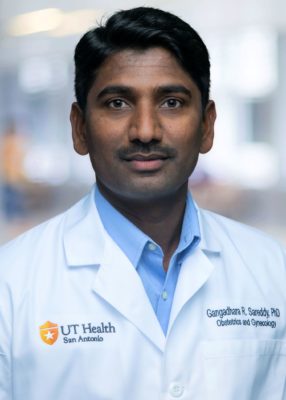
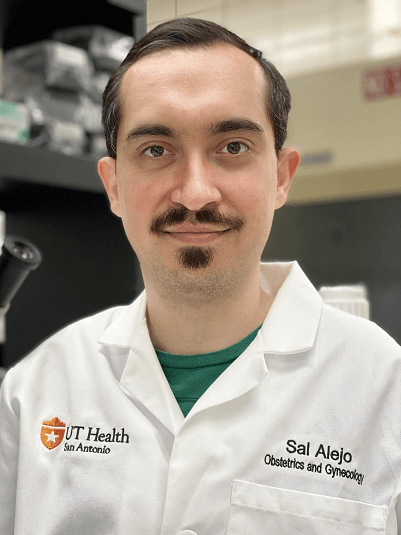
The molecule, known as NCD38, targets a specific subset of GBM cells called glioma stem cells. By disrupting their highly efficient DNA repair activity, NCD38 offers new treatment possibilities. “Glioma stem cells are notoriously difficult to treat,” said Gangadhara Sareddy, PhD, corresponding author of the study and associate professor of obstetrics and gynecology at the Joe R. and Teresa Lozano Long School of Medicine at the Health Sciences Center. Sareddy is also a researcher at Mays Cancer Center, one of four National Cancer Institute-designated cancer centers in Texas.
Chemotherapy and radiation therapy primarily damage the DNA of glioblastoma tumor cells, slowing tumor growth. However, glioma stem cells possess a high capacity to repair this DNA damage, contributing to treatment resistance. NCD38 inhibits an enzyme called Lysine-Specific Histone Demethylase 1A (KDM1A), which plays an important role in DNA repair in glioblastoma. “This enzyme is highly expressed in glioblastoma, and patients with high KDM1A expression tend to have lower overall survival,” Sareddy explained.
Improved survival
The study involved the implantation of GBM tumors in mice, followed by randomization into treatment groups. Mice in the treatment groups received either NCD38, the chemotherapy drug temozolomide, or a combination of the two. A control group received a non-active placebo. Mice receiving the combination of NCD38 and temozolomide demonstrated the longest survival rates. By inhibiting KDM1A activity and interfering with cancer DNA repair, NCD38 enhanced the anticancer effects of temozolomide. “While mice in the untreated group succumbed to GBM within two to three weeks of implantation, those in the combination therapy group — NCD38 with temozolomide — survived four to five weeks,” Sareddy said.
New paradigms
Although the study has not yet been conducted in humans, the potential benefits seen in mice could translate into significant improvements in two- to three-year survival for patients. “Identifying the mechanisms that regulate DNA repair in glioma stem cells may unveil new paradigms for curbing the growth and recurrence of GBM, thereby improving patient outcomes,” noted the lead author. Salvador Alejo, a medical student in the South Texas Medical Scientists Training Program at the University of Texas Health Sciences Center at San Antonio. His research focused on this topic.
Further studies are needed to assess the safety and effectiveness of this treatment strategy. Nevertheless, the promising results of this study give hope for the development of new strategies to combat GBM treatment resistance and pave the way for better patient care.
Thanks
Funding came from the National Institutes of Health (NS106173-01A1 to Gangadhara Sareddy, CA269866 to Ratna K. Vadlamudi, GM113896 to Salvador Alejo, TR002647 to Salvador Alejo, T32CA148724 to Jessica D. Johnson, CA054174 and 1S10OD021805-01); the Max and Minnie Tomerlin Voelcker Fund (in Gangadhara Sareddy); and the Texas Cancer Prevention and Research Institute (RP160732).
All animal experiments were conducted according to institutional guidelines after obtaining approval from the Health Sciences Center Institutional Animal Care and Use Committee.
Lysine-specific histone demethylase 1A (KDM1A/LSD1) inhibition attenuates DNA double-strand break repair and increases temozolomide efficacy in glioblastoma
Salvador Alejo, Bridgitte E Palacios, Prabhakar Pitta Venkata, Yi He, Wenjing Li, Jessica D Johnson, Yihong Chen, Sridharan Jayamohan, Uday P Pratap, Kyra Clarke, Yi Zou, Yingli Lv, Korri Weldon, Suryavathi Viswanadhapalli, Zhao Lai, Zhenqing Ye, Yidong Chen, Andrea R Gilbert, Takayoshi Suzuki, Rajeshwar R Tekmal, Weixing Zhao, Siyuan Zheng, Ratna K Vadlamudi, Andrew J Brenner, Gangadhara R Sareddy
First published: January 18, 2023, Neuro-oncology
https://doi.org/10.1093/neuonc/noad018
University of Texas Health Sciences Center at San Antonio (UT Health San Antonio) is one of the nation’s leading health sciences universities and is designated as a Hispanic-serving institution by the United States Department of Education. With teaching, research, patient care and community engagement missions, its graduate schools of medicine, nursing, dentistry, health professions and biomedical sciences have graduated more than 41,100 graduates who lead change, advance their fields and bring hope to patients and their families. throughout South Texas and around the world. To learn more about the many ways “We make lives better®”, visit UTHealthSA.org.
Stay connected with the University of Texas San Antonio Health Sciences Center on Facebook, Twitter, LinkedIn, instagram And Youtube.
Mays Cancer Center, home to UT Health San Antonio MD Anderson Cancer Center, is one of only four National Cancer Institute-designated cancer centers in Texas. Mays Cancer Center provides cutting-edge cancer care, powers innovative cancer research, and educates the next generation of leaders to end cancer in South Texas. To learn more, visit www.UTHealthSAMDAnderson.org.
Stay connected with the Mays Cancer Center on Facebook, Twitter, LinkedIn, instagram And Youtube.
The Department of Obstetrics and Gynecology at the Joe R. and Teresa Lozano Long School of Medicine at UT Health Science Center San Antonio develops the next generation of leaders in academic obstetrics and gynecology, conducts research leading to advances in women’s health care, provides excellent medical care to women in San Antonio and South Texas, and participating in the continuing medical education of family physicians and obstetrician-gynecologists.
|
Sources 2/ https://news.uthscsa.edu/molecule-shows-potential-to-combat-treatment-resistance-in-brain-tumor-glioblastoma/ The mention sources can contact us to remove/changing this article |
[ad_2]