
[ad_1]

 Getty Images
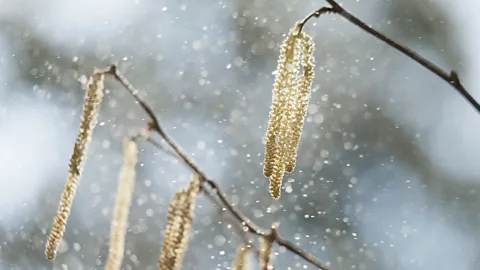
Seasonal allergy sufferers are being hit with more pollen over a longer season due to rising temperatures, but global warming is also triggering alarming extreme allergy events, say experts.
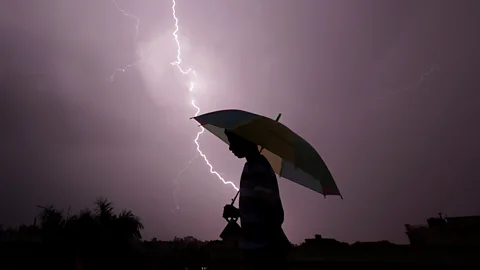
People could see the thunderstorm, but they couldn’t see what was going on inside it. Trillions of pollen particles, sucked up into the clouds as the storm formed, were now being splintered by rain, lightning and humidity into ever-smaller fragments – then cast back down to Earth for people to breathe them in.
It was around 18:00 on 21 November 2016 when the air in Melbourne, Australia, turned deadly. Emergency service phone lines lit up, people struggling to breathe began flooding into hospitals, and there was so much demand for ambulances that the vehicles were unable to reach patients stuck at home. Emergency rooms saw eight times as many people turning up with breathing problems as they would normally expect. Nearly 10 times as many people with asthma were admitted to hospital.
In total, 10 people died, including a 20-year-old law student who passed away on her lawn, waiting for an ambulance while her family tried to resuscitate her. One survivor described how he had been breathing normally and then, within 30 minutes, found himself gasping for air. “It was insane,” he told reporters from his hospital bed.
Paul Beggs, an environmental health scientist and professor at Macquarie University in Sydney, Australia, remembers the incident well. “It was an absolutely massive event. Unprecedented. Catastrophic,” he says. “The people in Melbourne, the doctors and the nurses and the people in pharmacies – they all didn’t know what was happening.”
It soon became clear that this was a massive case of “thunderstorm asthma”, which occurs when certain types of storms break up pollen particles in the air, releasing proteins and showering them on unsuspecting people below. The widely dispersed proteins can trigger allergic reactions in some people – even among those who weren’t previously asthmatic.
 Getty Images
Thunderstorm asthma events like the one that hit Melbourne are one extreme example of how pollen from plants and the allergies it causes are being dramatically altered by climate change. As temperatures rise, many regions – especially the US, Europe and Australia – are seeing seasonal allergies affect an increasing proportion of people, over a longer season and with worse symptoms, say scientists.
Pollen itself is an essential and ever-present part of our world. These microscopic particles pass between plants, enabling them to reproduce. While some plants spread their pollen with the help of insects, others rely on the wind, sending huge volumes of this powdery substance airborne. Many trees, grasses and weed species rely upon wind dispersal for their pollen. It is these that are especially likely to cause seasonal allergies, or hay fever.
This occurs when your immune system mistakenly identifies the pollen as a harmful substance, triggering a response normally reserved for pathogenic bacteria or viruses. Common symptoms can include a runny nose, itchy eyes and sneezing. In some cases, seasonal allergies can trigger breathing difficulties when inflammation in the airways leads to swelling, making it hard to get enough air into the lungs.
While it isn’t possible to determine exactly how much climate change influenced the 2016 thunderstorm asthma incident in Melbourne, Beggs is “reasonably certain” it had some impact.
How thunderstorms supercharge pollen
Exactly how thunderstorms trigger or exacerbate asthma in this way is still not fully understood. The leading theory is that cold air downdrafts that occur during thunderstorm weather systems generate strong cross winds that blow at ground level, whipping up pollen grains and fungal spores from grass and plants. These then get carried high into the storm system by updrafts, where moisture in the clouds causes them to swell and break apart into smaller fragments, massively increasing the number of allergen particles in the air. The strong electric field that develops during thunderstorms may also enhance the rupture of the pollen.
Thankfully, major thunderstorm asthma events remain rare. But climate change is increasing people’s risk of pollen exposure in other ways, too.
For one thing, rising temperatures mean that pollen seasons – when plants emit pollen, typically during spring and summer – are starting earlier and lasting longer, says Elaine Fuertes, a public health scientist who focuses on the environment and allergic disease at the National Heart and Lung Institute, Imperial College, UK. “You’re going to get people who experience symptoms earlier in the year, for a longer period of time,” she says.
In parts of the world, including the US and Europe, one of the key culprits is ragweed – a widespread group of flowering plants that many people consider to be weeds. There are various species of ragweed around the world but they can produce mind-bending amounts of pollen. A single plant is capable of emitting one billion pollen grains, for example. Ragweed grows in gardens and farmland but also in nooks and crannies in urban environments.
Allergies to ragweed pollen already affect some 50 million people in the US alone. A study analysing data from 11 locations in North America between 1995 to 2015 found that 10 of those locations experienced longer ragweed pollen seasons – sometimes much longer. During that 20-year period, the season lengthened by 25 days in Winnipeg, Manitoba, 21 days in Fargo, North Dakota and 18 days in Minneapolis, Minnesota.
“The winter warms, the springs are starting earlier, and the falls are being delayed, and so the time that you spend outdoors in contact with allergic pollen is definitely going up,” says Lewis Ziska, associate professor of environmental health science at Columbia University, in New York, US, and one of the scientists who researched the ragweed pollen season.
These changes get more drastic in northern parts of North America, Europe and Asia, Ziska says. But also in Australia and the southern parts of South America and Africa.
 Alamy
AlamyIt isn’t just that people are being exposed to allergens for longer. It is also that the amount of allergens in the air are increasing in many parts of the world. In the 2000s, the pollen season in the continental US started three days earlier than it did during the 1990s, but crucially, the amount of pollen in the air was also 46% higher.
This is partly because carbon dioxide (CO2) levels in the atmosphere are rising, due to emissions from human activities. And many of the most bothersome plants for hay fever sufferers thrive on CO2.
When researchers grew a certain type of grass under different CO2 levels, for example, they found that plants grown in an atmosphere containing CO2 at 800 parts per million (ppm) had flowers that produced about 50% more pollen than plants grown in air containing 400ppm. The latter mimics current levels of CO2 in Earth’s atmosphere.
Ziska, who authored the 2022 book Greenhouse Planet, ran similar experiments with ragweed. His results mirror those of other researchers. “Every time we cranked up the carbon dioxide, the ragweed plants responded. They grew more. They produced more pollen,” he says. “And there was some evidence that they were producing a more allergenic form of the pollen, one that could induce your immune system to respond even to a greater extent than had been in the past.”
The spread of invasive species across new parts of the world is also triggering allergic reactions in new populations of people. While originally from North America, ragweed, for example, has spread across Europe, as well as into Australia, Asia and South America. Already, some 60% of people in Hungary, 20% in Denmark and 15% in the Netherlands are reportedly sensitive to the pollen from this prolific group of plants.
 Getty Images
About one-third of the increase is due to the continuing spread of the invasive species, the researchers note. The remaining two-thirds is specifically due to climate change, including the lengthening of the growing season as temperatures warm. “So it’ll be an earlier season, a longer season, as well as a more intense season for those who experience allergic symptoms – and then a higher risk of new sensitisation for a previously unexposed population,” Fuertes says.
Not every region in the world will see more pollen production. Some researchers have found that southern California, for example, will experience earlier but less productive pollen seasons, largely as a result of reduced rainfall.
Relatively speaking, the amount of pollen in the air will still vary from year to year, Fuertes points out. But that may not be of much help to hay fever sufferers. “Once you’re sensitised and go on to develop allergic symptoms, you’ll still likely experience symptoms during years when pollen levels may be lower than average,” she says. “You’ll react to the pollen that’s around.”
So, what can people do about this? Cutting carbon emissions would help to avert some of the worst climate impacts and other strategies might also mitigate the problem.
It might be possible to make some drastic but direct interventions, for example. A century ago, some US cities even set up commissions to tackle ragweed. “Chicago employs 1,350 in hay fever fight,” blares one headline from 1932. The news story explains that men – otherwise unemployed during the Great Depression – were paid the equivalent of one week’s food and lodging (and “25 cents in cash”) for each day they spent cutting down the plant.
 Getty Images
Other solutions lie in smarter urban design. “We should definitely green our cities,” Fuertes says. “But we do need to do it thoughtfully.”
Planting of exotic species, for example, can trigger new allergies. Opting for the male, pollen producing trees in some species over “messy” fruit and seed producing female ones – so-called “botanical sexism” – can also increase pollen levels in urban areas, although studies have shown the effect of this bias is relatively small in major cities such as New York.
It is also important to monitor and forecast pollen levels, scientists say. “We need to know what we’re breathing in. That’s a pretty fundamental thing in terms of our health,” says Beggs, who points out that while most people take it for granted that they can get reliable, real-time, validated information on metrics like temperature or rainfall in their area, relatively few can say the same for airborne allergens.
But even those services that are modelling pollen counts in an extensive, detailed way – such as the Finnish Meteorological Institute – aren’t monitoring or modelling airborne allergen levels, which are more accurate as each pollen grain can release different amounts of allergens and they can vary by the weather conditions. These are a different measurement, Fuertes points out, and one that she’s shown is more closely linked to allergy symptoms. “Nobody is measuring allergen levels on a routine basis,” Fuertes says. “We should be moving towards that.”
Overall, experts say, the science is clear. Without concrete, coordinated action, climate change will continue to make hay fever worse across many regions of the world. This might include more dramatic, deadly events like thunderstorm asthma. But it might also mean more people sniffling and suffering, for a longer season, every year.
“We have the studies now to show that it’s really having an impact on human health,” says Beggs. “And there’s more to come.”
|
Sources 2/ https://www.bbc.com/future/article/20250410-how-climate-driven-thunderstorms-supercharge-pollen-allergies The mention sources can contact us to remove/changing this article |
[ad_2]