
[ad_1]
Levent Kenez/Stockholm
The Turkish Grand National Assembly’s Human Rights Committee on July 14 refused to form a subcommittee to investigate allegations of human rights violations against Uyghur Muslims in China’s Xinjiang region. Instead, it was decided to appoint an existing subcommittee, which had previously focused on racism and Islamophobia during the previous legislative term, to deal with the issue.
Yksel Seluk Trkolu, a member of the Human Rights Committee from the Y (Good) Party, stated that among the tasks of the committee is the investigation of issues related to human rights within the framework of international agreements that Turkey is a supporter of and proposing solutions. The motion suggested the creation of a subcommittee to conduct appropriate research and investigations into the allegations regarding the Xinjiang-Uyghur Autonomous Region, also known as East Turkestan, the ancestral homeland of the Turks. The subcommittee will focus on allegations of forced placement of Uyghurs, Kazakhs and other Turkic minorities in camps, as well as human rights violations that have drawn global attention.
However, the chairman of the committee and a member of the ruling Justice and Development Party (AKP), former minister Derya Yank said that there is no need to create a special committee on Uyghurs. Instead, Yank proposed re-establishing the Subcommittee on Islamophobia and Anti-Racism, which was active during the previous legislative period. Yank suggested that the recommendations included in Trkolu’s proposal could be addressed by this subcommittee, which was seconded by other committee members. Trkolu did not participate in the voting, and other opposition representatives did not protest.
Minutes of the committee meeting of the Milli Majlis:
commission_minute Human Rights Commission
It is no secret that while Turkey is going through difficult economic times, the government led by President Recep Tayyip Erdogan is determined to avoid a serious crisis with China, as the government has been able to obtain cheap loans and support in meeting its demand for foreign currency through swap agreements with China.
However, the government aims to appear to be taking steps in favor of the Uyghurs where it will not create a crisis with China, so as not to alienate its Islamist base and retain the support of nationalist groups.
For example, at the meeting of the Foreign Relations Committee of the parliament on June 22, the approval of a number of international agreements with Palestine was removed from the agenda. The decision was made following Palestinian President Mahmoud Abbas’s reference to the Uyghur issue and his alleged support for China’s counter-terrorism efforts during a visit to China in June.
In response to Abbas’s statement, the leader of the Nationalist Movement Party (MHP), a partner in the government coalition, invited Uyghur businesswoman and political activist Rabia Kadir to Turkey during a meeting with party members on June 24. Before that, Erdogan’s government banned Kadir from entering the country.
In a statement issued by the Palestinian embassy in Ankara, it was clarified that President Abbas did not make any statement regarding the Uyghur Turks.
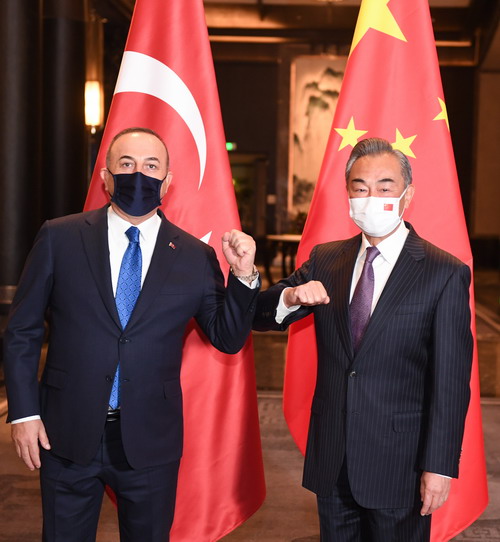
Meanwhile, Palestinian President Abbas arrived in Ankara on Monday at the invitation of President Erdogan. Abbas’s visit to Turkey is a message that the Turkish government prioritizes Palestinian concerns, especially ahead of a planned July 28 meeting between Erdogan and Israeli Prime Minister Benjamin Netanyahu in Ankara. However, despite Israeli officials not making an official statement, Israeli media reported that Netanyahu’s visit to Turkey, originally scheduled for July 28, was postponed due to Netanyahu’s health problems.
For decades, Turkey has helped and protected the Uyghurs, who share many cultural and linguistic characteristics with Turks and are seen as ethnic brothers by Turkish nationalists. But Erdogan’s government changed this policy in 2019 and deported several Uighurs to China. Moreover, as international condemnation of China’s crackdown on the Uyghurs in Xinjiang has grown, Turkey has remained silent on China’s economic and political influence. Moreover, the Turkish government has refused to join 23 countries in a joint statement calling on China to end abuses against the Uyghur minority at the United Nations in 2020.
Turkey has been deporting or refusing to let Uyghur activists into the country since 2019 to avoid a negative reaction from China. Proposals in the Turkish parliament to condemn China or to create a commission of inquiry into the Uyghurs in the parliament are systematically rejected by the votes of the Islamist ruling party. The Turkey-China extradition treaty signed in 2017 is still awaiting approval in the Turkish parliament. Although Erdogan’s government has not yet submitted the agreement for ratification due to possible negative reactions at home, it continues to deport Uyghurs.
The leader of the World Uyghur Congress, Dolkun Isa, was not allowed to enter Turkey in September and was forced to return to Germany, where he lives.
|
Sources 2/ https://nordicmonitor.com/2023/07/turkish-parliament-rejects-a-special-commission-on-human-rights-violations-against-uyghurs/ The mention sources can contact us to remove/changing this article |
[ad_2]