
[ad_1]
Richard Drury / DigitalVision via Getty Images
iShares Core MSCI Total International Stock ETF (NASDAQ: IXUS) is an exchange-traded fund that provides exposure to “a broad range of international companies from developed and emerging markets”, outside the United States, with an emphasis on diversification global and profitability. The expense ratio of the fund is 0.09%, as stated in the prospectus. As of January 7, 2022, IXUS had $ 32.75 billion in assets under management.
It is important to note that IXUS has many holdings; 4,295 as of January 6, 2022. The greater the number of holdings (ie the more diversified), the more likely a fund is to track larger indices. In other words, IXUS is more likely to represent a source of “beta” than to offer “the alpha” (or the potential to outperform). However, IXUS does not invest in US equities; it invests abroad, which constitutes implicit currency hedging, and offers a certain loophole for American markets (more specifically for American investors).
The IXUS benchmark, the MSCI ACWI ex USA IMI Index (ACWI stands for All Country World Index) had 6,722 components as of December 31, 2021. Nonetheless, the larger holdings within IXUS reflect the larger of its chosen benchmark (whose performance it seeks to replicate. ). We can therefore safely use the indicative data provided by the most recent fact sheet to assess the valuation of IXUS.
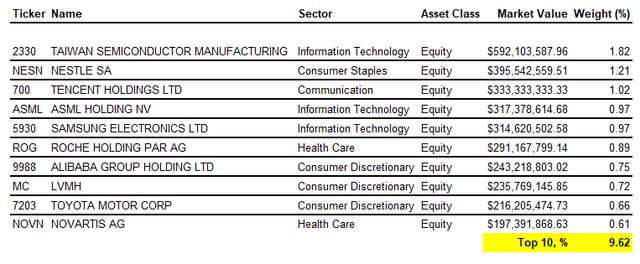
(Produced by the author using data from iShares)
As of December 31, 2021, the IXUS benchmark index exhibited a rolling price / earnings ratio of 16.86x, a forward price / earnings ratio of 14.32x (i.e. a return on earnings forward of 6.98%, which is relatively high) and a price / book ratio of 1.87x (relatively inexpensive). These figures also imply a forecast return on equity of around 13% (forecast profit over book value). This is reasonable, although not high (many top US equity funds offer ROEs of over 20%, but the funds also trade at much higher valuations).
The main geographic exposures include certain markets which are generally cheaper than the US markets: Japan and the United Kingdom are, for example, the first exposures. Japanese and UK stocks are often associated with “value”, due to their cheaper valuations and underperformance relative to growth stocks.
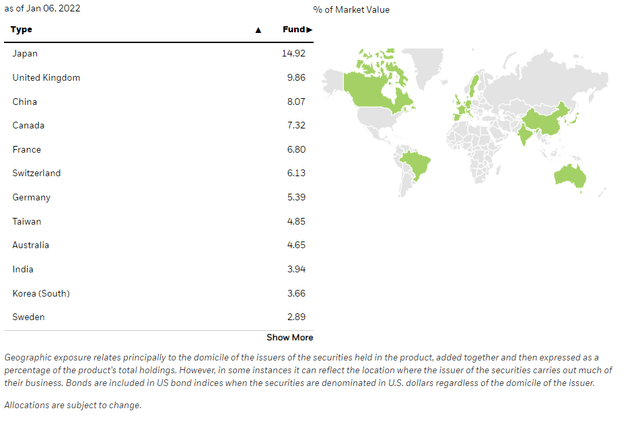
(iShares)
It is uncertain whether these markets will rebound, although a contraction US monetary policy (as expected) in 2022 could put pressure on discounted tech equity cash flow valuations, making “value markets” more attractive. Either way, IXUS might be ‘safer’ if the tightening of monetary policy exceeds expectations, and therefore regardless of valuation, IXUS might still represent a reasonable addition to a larger equity portfolio.
Professor Damodaran recently published an updated risk premium on equities in mature markets as of January 1, 2022 of 4.90%, as well as updated estimates of country risk premiums, which are important in this case because we have to produce a weighted cost of equity for IXUS. That is, due to all of the fund’s geographic exposures outside the United States.
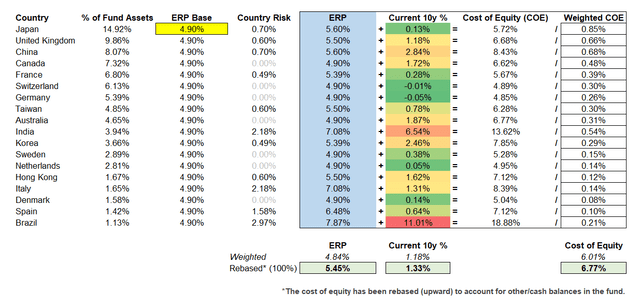
(Author’s calculations: ERP data from Professor Damodaran; and government bond yields, as the risk-free rate, on global government bonds.)
By my calculations, the fair cost of equity for IXUS is 6.77%. This is the return we should demand. In combination with the previous data presented, I am also relying on Morningstar analyst estimates which indicate the potential for a three to five year average earnings growth rate at 13.89% (as of January 2022). I’m working this out in the short-term rating gauge below, eventually averaging around 13.1% by year five.
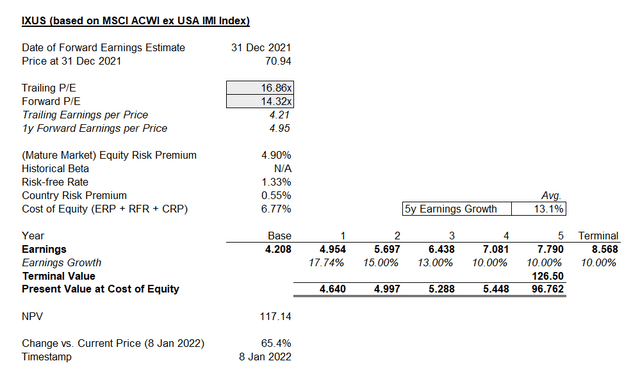
(Author’s calculations)
65% increase in implied values, based on our current cost of equity estimates, suggesting the fund is undervalued. In more realistic terms, this means that the implied returns are above 6.77% per annum; To resolve fair value, we look for returns of around 10.78% per annum, if we expect the implied “high” risk premium to hold. Alternatively, if the long-term ERP were 6.77% to assess terminal year earnings in year five, the implied IRR would be well above 15% based on the same earnings projections.
It’s safer to assume that flows to international equities, which appear to be trading at relatively cheap valuations, will remain about as stable as in the past. That is, “at best”, given that the entries into IXUS have been strong. Based on the data below, year-over-year rolling inflows were positive at + $ 6.35 billion for IXUS alone.
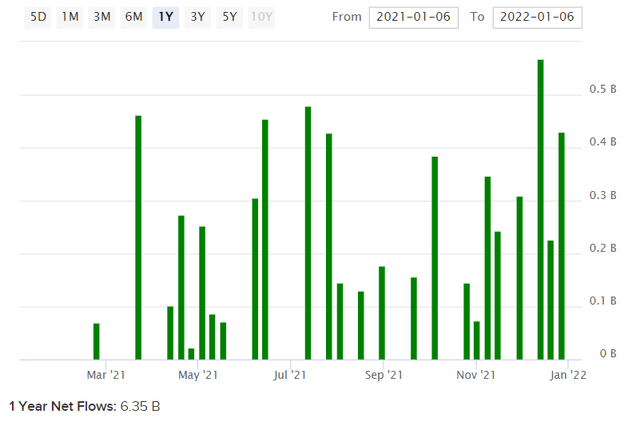
And yet, the risk premium seems implicitly high. So I would expect the cost of equity to stay at a higher rate, but the potential for returns of over 10% per year for the next several years is still in the offing. This is also supported by an underlying futures ROE of 13% (i.e. if the price / book ratio were constant, the returns for the following year would theoretically be 13%).
In addition, the forward earnings return of just under 7% at the current market price for IXUS is quite high, given that the fund-weighted 10-year yield (weighted by geographic exposures) is not than 1.33% according to my calculations. International stocks actually look quite cheap and would seem able to withstand higher interest rates globally if other central banks follow suit (after the US tightening).
I would remain cautiously bullish on international equities; given the relatively modest underlying returns on equity, a large position is not favorable. But earnings projections and an implicitly reasonable cost of equity would appear to support the valuation of IXUS. Since IXUS will tend to correlate with broader markets, this would also help support a bullish view of equities as an asset class more broadly.
|
Sources 2/ https://seekingalpha.com/article/4478649-ixus-international-stocks-are-undervalued The mention sources can contact us to remove/changing this article |
[ad_2]