
[ad_1]
“This new research highlights vast economic and political power of large formula milk companies, as well as serious public policy failures that prevent millions of women from breastfeeding their children,” said Nigel Rollins, one of the authors of a series on the $55 billion-a-year industry and their marketing “playbooks,” published in the journal peer-reviewed medicine The Lancet.
“Actions are needed in different areas of society to better support mothers to breastfeed for as long as they want, alongside efforts to tackle the over-marketing of infant formula once and for all,” he added.
650 million people have no “maternity protection”
The series of three articles recommends much greater support for breastfeeding within health and social care systems, including ensuring sufficient paid maternity leave.
Currently, approximately 650 million women lack adequate maternity protectionsnote the newspapers.
Written by a group of doctors and scientists, the series examines how the formula marketing tactics undermine breastfeeding and targeting parents, health professionals and politicians, and how feeding practices, women’s rights and health outcomes are shaped by power imbalances and political and economic structures.
“Breastfeeding is not the sole responsibility of women and requires collective societal approaches that take gender inequalities into account,” the authors wrote. Indeed, reviews from 2016 to 2021 and country case studies indicate that breastfeeding practices can be improved rapidly through multilevel and multicomponent interventions.
Misleading Claims by Dairy Lobbyists
The World Health Assembly has already addressed the decades-long problem of questionable marketing practices among infant formula producers. In 1981, he developed the International Code of Marketing of Breastmilk Substitutes, following an investigative report on Nestlé’s targeted marketing in low- and middle-income countries in the 1970s.
The new series said misleading marketing claims and strategic lobbying by the dairy and formula industries add to the challenges parents face.
Claims such as suggesting formula milk eases irritability, can help with colic and prolong nighttime sleep, only increase parents’ anxiety, according to the papers.
Linda Richter, of the University of Witwatersrand, South Africa and co-author of the series, said the formula industry uses “mediocre science” to suggest, with little supporting evidence, that their products are “solutions to common infant health and development problems”.
This marketing techniqueclearly violates the 1981 Codethat says labels shouldn’t idealize the use of formulas to sell more products,” she added.
The immense benefits of breastfeeding
WHO recommends exclusively breastfeeding infants for at least six months. The practice offers immense benefits to babies and young children, from reducing the risk of infection to lowering rates of obesity and chronic disease later in life.
However, globally, only about half of newborns are put to the breast within the first hour of life.
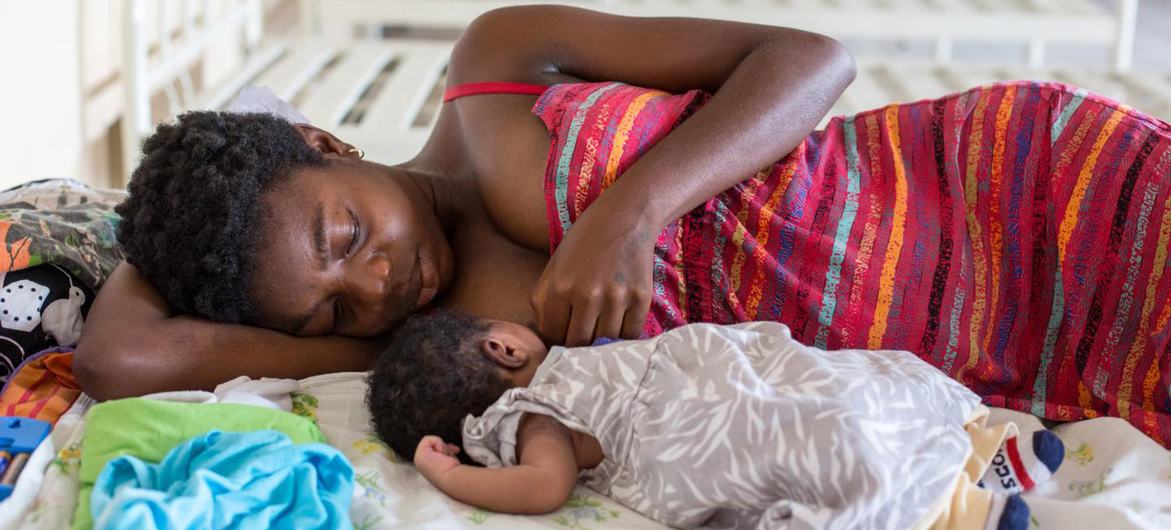
A mother breastfeeds her baby at an infant health center in Kinshasa, Democratic Republic of Congo.
Companies exploit the lack of support
At a time when less than half of newborns are breastfed, in line with WHO guidelines, the series explains how the industry marketing exploits the lack of support for the practice by governments and society.
The tactic also abuses gender politics to sell its products, frame the defense of breastfeeding as a “moralizing judgment” while promoting formula as a “convenient and empowering solution” for working mothers, the authors found.
Politicizing breast milk
Drawing attention to the power of the formula industry to influence national policy decisions, the series said the companies also interfere with international regulatory processes. For example, the dairy and infant formula industries have established a network of unaccountable trade associations that lobby against policy measures to protect breastfeeding or control the quality of infant formula.
Faced with these pressures on parents, the authors of the series made several recommendations; among them was a need for broader actions in workplaces, healthcare, governments and communities, to effectively support women who want to breastfeed. They also called for formal recognition of the contribution of women’s unpaid care work to national development.
Set of recommendations
Series co-author Rafael Pérez-Escamilla, of the Yale School of Public Health, pointed to other critical steps.
“Given the immense benefits of breastfeeding for their families and national development, women who want to breastfeed need to be much better supported so that they can achieve their breastfeeding goals,” he said.
“A broad expansion of education for healthcare professionals on breastfeeding, as well as statutory paid maternity leave and other protections are essential.”
|
Sources 2/ https://news.un.org/en/story/2023/02/1133297 The mention sources can contact us to remove/changing this article |
[ad_2]