
[ad_1]
Greeks were voting on Sunday in the first election since their country’s economy ceased to be under strict surveillance and control by international lenders who had provided bailout funds during its nearly ten years.
The vote pits conservative Prime Minister Kyriakos Mitsotakis, 55, a former Harvard-educated banking executive, against Alexis Tsipras, 48, who leads the left-wing Syriza party and served as prime minister during some of the most turbulent years of the financial crisis. , as the two main contenders.
The rising cost of living was at the forefront of many voters’ minds as they made their way to polling centers set up in schools across the country.
Every year, instead of getting better, things get worse,” said Athens resident Dimitris Hondrogiannis, 54. “Things are expensive. Every day things get out of control. It’s enough to scare you from going to the supermarket to do your shopping. Well, see how things go.
Hondrogiannis said he hoped for a stable government that would help reduce the prices of food and general goods. People can’t make ends meet,” he said.
Although Mitsotakis has been consistently ahead in opinion polls, a new proportional representation electoral system makes it unlikely that whoever wins the election will be able to secure enough seats in Greece’s 300-member parliament to form a government without seeking partners. of coalition.
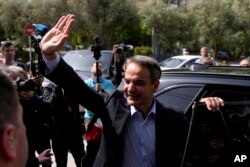
The winner of Sunday’s elections will have three days to negotiate a coalition with other parties. If that fails, the mandate to form a government passes to the second party and the process repeats itself. But deep divisions between the two main parties and four smaller ones set to enter parliament mean a coalition will be hard to come by, making a second election likely, probably on July 2.
The second election would be held under a new electoral law that makes it easier for a winning party to form a government by granting it a bonus of up to 50 seats in parliament, calculated on a sliding scale based on the percentage of votes obtained.
A total of 32 parties are in the running, although opinion polls indicate that only six have a realistic chance of reaching the 3% threshold for seats in parliament.
The once-dominant socialist Pasok party in Greece is likely to be at the center of any coalition negotiations. Overtaken by Syriza during the Greek financial crisis of 2009-2018, the party stands at around 10%. Its leader, Nikos Androulakis, 44, was at the center of a wiretapping scandal in which his phone was targeted for surveillance.
Pasok would be vital in any coalition deal, but Androulakis’ poor relationship with Mitsotakis, whom he accuses of covering up the wiretapping scandal, means a deal with the Tories is unlikely. His relationship with Tsipras is also bad, accusing him of trying to poach Pasok voters.
The far-right Greeks party, founded by a jailed former lawmaker with a history of neo-Nazi activity, has been barred from participation by the Supreme Court. His former party, Golden Dawn, which became Greece’s third party during the financial crisis, was considered a criminal organization.
Heading into the election, Mitsotakis had enjoyed a double-digit lead in opinion polls but saw that erode following a February 28 train disaster that killed 57 people after an intercity passenger train was accidentally put on the same track. like an oncoming freight train. It was later revealed that the stations were understaffed and security infrastructure was broken and outdated.
The government has also been battered by a surveillance scandal in which journalists and prominent Greek politicians, including Androulakis, discovered spyware on their phones. The revelations have deepened mistrust between the country’s political parties at a time when consensus may be sorely needed.
Tsipras campaigned extensively on the train disaster and wiretapping scandal.
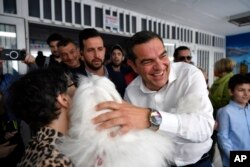
In power since 2019, Mitsotakis has seen surprisingly high growth, a sharp drop in unemployment and a country on the verge of returning to investment grade in the global bond market for the first time since losing market access. in 2010, at the start of its financial crisis.
Debts to the International Monetary Fund were repaid earlier. European governments and the IMF injected 280 billion euros ($300 billion) into the Greek economy in the form of emergency loans between 2010 and 2018 to prevent the euro zone member from going bankrupt. In return, they demanded punitive cost-cutting measures and reforms that saw the country’s economy shrink by a quarter.
A severe recession and years of emergency borrowing have left Greece with a huge national debt that reached 400 billion euros last December and has weighed on household incomes, which will likely need another decade. to straighten up.
Retired Bank of Greece employee Evangellos Tassis, 78, said he could still make ends meet on his pension. We are from an older generation and we were a bit lucky. You young people are struggling now,” he said.
Tassis said he hoped the election would produce better days. That’s it. What else can I say?
The other three parties with realistic chances of parliamentary seats are the Communist Party of Greece, or KKE, led by Dimitris Koutsoumbas; the leftist European Realist Disobedience Front (MeRA25), led by Tsipras’ flamboyant former finance minister; and the right-wing Elliniki Lysi, or Greek Solution, led by Kyriakos Velopoulos.
The KKE, a staple of Greek politics, has enjoyed a steady core of support around 4.5% to 5.5% over the past decade, while Varoufakis’ party has polled just over the parliamentary threshold by 3%. Velopoulos’ party elected 10 deputies in 2019 and looks set to re-enter parliament.
|
Sources 2/ https://www.voanews.com/a/greece-votes-in-first-election-since-international-bailout-spending-controls-ended/7102454.html The mention sources can contact us to remove/changing this article |
[ad_2]