
[ad_1]
By Honorary JournalistAsk Claudia Agatha and As holy from Indonesia
Photo =Embran Nawawi
Last month’s annual East Java Fashion Harmony show was held at Bromo Tengger Semeru National Park in East Java, Indonesia. Gyeongsangnam-do Province of Korea cooperated with East Java as a twin province to make three batik clothes (traditional Indonesian cloth) with Jinju silk provided by the Jinju Jinju Culture and Tourism Foundation, Gyeongsangnam-do.
In an interview via social media on January 3, fashion designer Embran Nawawi created pieces inspired by traditional Korean and Indonesian clothing.

Embran Nawawi
Introduce yourself briefly.
I am Embran Nawawi, a designer and lecturer in textile and fashion promotion and entrepreneurship courses at Petra Christian University and Widya Mandala Catholic University, both in Surabaya, East Java. I have been designing clothes with East Javanese batik patterns for 15 years. I am also a fashion event creator for the East Java Ministry of Tourism and Creative Economy office.
Why did you collaborate with Korea on last year’s event?
I was invited to think about a collaborative concept related to the twin provinces of East Java. While looking for something to match the theme of the show “Wisdom to Majestic”, I found that the traditional Hanbok is still part of modern fashion in Korea. This led to my idea to use batik designs in certain parts of the Hanbok.
I was also invited to use silk from Jinju, which is usually made from Hanbok. It was a challenge at first to get used to the characteristics of silk and to adapt the batik-making process for the cloth. The technical difficulties included how the wax held tightly to Jinju silk and how the strong absorption of color to create the volume of dye needed was so unpredictable.
But the silk I got from Jinju exceeded my expectations. I hope to reuse Jinju silk to make classic batik from other cities such as Tulungagung and Tuban.

Inspired by the high-waist Hanbok element, Embran Nawawi created this palazzo jumpsuit using organza silk from the Korean city of Jinju and decorated with a batik dyeing technique.
Describe three outfits you designed.
All three are inspired by couture and the shape of Hanbok, especially the high waist elements which I translated into palazzo jumpsuit pants and transparent Korean outers. In another section I made a simple dress inspired by the shape of a Hanbok skirt and paired it with a unique transparent kimono. Finally, I combined the men’s Hanbok style with Indonesian style by including the Kembang Suro batik motif which symbolizes sincerity and dedication, besides that Kawung symbolizes eternity and Liris symbolizes diversity. These patterns are used with Korean phoenix and lotus flower designs, which have similar meanings.
Why did you combine Jinju silk with Probolinggo batik?
Probolinggo was an influential trading center during Indonesia’s Majapahit empire and where one of the country’s oldest batik patterns originates such as Kembang Suro. Combining my country’s best batik with Korea’s best silk through the hands of Batik Poerwa maestro is an extraordinary experience.
As traditional clothing remains relevant in modern Korean fashion, I believe this kind of cultural collaboration can create lasting fashion waves around the world. I’m looking forward to my next collaboration with Korean fashion.
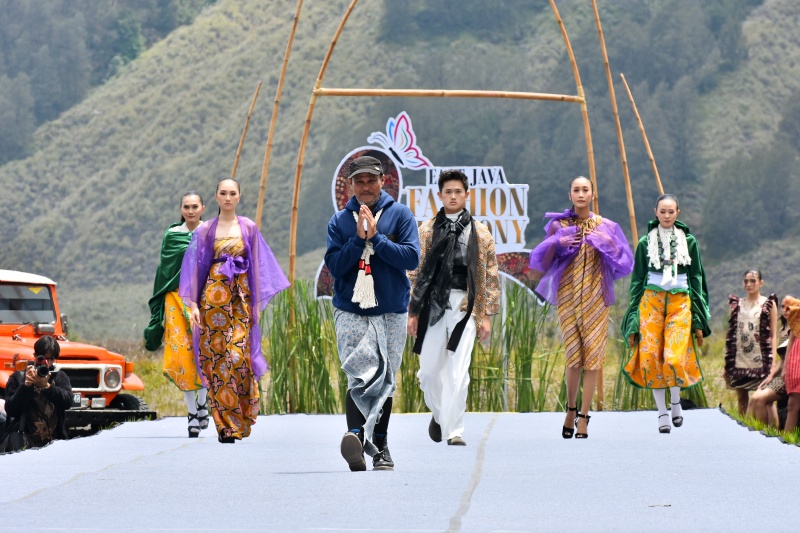
Embran Nawawi stood on stage with models wearing his creations.
*This article was written by Korea.net Honorary Reporter. Our group of Honorary Reporters come from all over the world, and they share their love and passion for Korea.net for all things Korean.
|
Sources 2/ https://news.google.com/__i/rss/rd/articles/CBMiU2h0dHBzOi8vd3d3LmtvcmVhLm5ldC9OZXdzRm9jdXMvSG9ub3JhcnlSZXBvcnRlcnMvdmlldz9hcnRpY2xlSWQ9MjI3MTgwJnBhZ2VJbmRleD0x0gEA?oc=5 The mention sources can contact us to remove/changing this article |
[ad_2]